Thursday, May 26, 2016

English heritage: A work experience

My bus trip from London was rather long and I arrived in Dover after night had fallen, in the pouring rain. Oh England.
However it was only a five minute walk to my accommodation, and I had no problems getting in and confirming my booking. The lady running the place was lovely and friendly, and soon showed me to my room so I could get a good nights sleep before beginning my first day of work. My room was small and cosy, and best of all it had an en-suite bathroom so I didn't have to leave my room unnecessarily. It also had a little electric jug so I could make myself tea! How English.

My accommodation was extremely well located, only a five minute walk from the town, and a ten minute walk from Dover castle where English Heritage was located. It was a steep climb up the hill, but the views over the harbor were breathtaking. Breakfast was included in my stay and the lovely Bulgarian lady insisted on me taking snacks for my day.

After the round of introductions to our small team - two supervisors in charge of us on the project and another lovely volunteer called Ashely  - we headed off to our first site called Richborough Roman fort. It was a wild and windy day and we were being blown sideways just standing there.

Although we were working on the small museum set up here at this site, we were allowed to go for a wander around which I very much enjoyed. Although there wasn't a lot left, these imposing walls were rather awe-inspiring. Additionally just knowing the history of this place made it exciting to be here - it is the probable landing place in 43 AD of the Roman invasion.
 I spent the morning going through my induction and reading through rules and regulations, and then the afternoon helping to clean the cases and make sure their temperature and humidity levels were what they should be. We soon learned what types of readings should be showing by comparing them to the previous checks done (if this type of work has one thing it is tonnes of records and paperwork!). Sachets not unlike those found in shoe-boxes but called Silica gel and Desi-clay are also used to absorb moisture and these also had to be checked and often replaced. This type of work all falls under the category of preventive conservation, which is just one of the many branches of work in museums and heritage.

Our second day was spent at Deal castle, a truly impressive fortress that I would recommend googling to get an idea of its true shape (a Tudor rose). Built by King Henry VIII (Yes the same one who tore down all the abbeys and chopped off heads - looks like he did build things too!) These were built due to a fear of the French sending an invading fleet. Due to this purpose, this castle was heavily fortified, featuring drawbridges, thick walls, murder holes and a ridiculous number of guns.

Since it was built, Deal castle has always had a captain, although later this title became purely honorary, the captain still lived within the castle until a few years ago. We went into his quarters to give the place a quick clean and it was horrifically dark and dismal. The idea of an old man living there by himself in this big empty castle struck me as rather sad.

Although we worked hard, we had fun too. Lunch-breaks were usually spent in the shop as it was warmest, where we would chat and drink tea. In this particular shop there were English Heritage branded alcohols for sale, including one bottle that had been opened as a tasting bottle - and that was how I first tried Mead, in a castle in England that we had all to ourselves!
I then spent the afternoon cleaning this nineteenth century linen box press. It required delicate handling so we used a pony hair brush for dusting and cleanly gently.


Cleaning was definitely the main part of this job, and although I enjoyed the meticulous care that went into this and learning about the different tools used, it also helped me realize that this was not the career path I wanted to go down. Some parts of it really did pique my interest however, such as the conservation work. Learning exactly how artifacts were conserved in their cases and the amount of thought that went into placing them (for example placing metal and wood together in a case would be very bad because of the different moisture levels they need) was extremely interesting to me. I also enjoyed working in these buildings when they were closed to the public as there was something special about wandering these ancient sites in silence. 

Our last site of the week was Lullingstone Roman Villa, where we began the task of cleaning the intricate mosaic floor. 


 Each individual tessera had to be cleaned with a hogs hair brush and vacuum nozzle without disturbing the mortar between; this required meticulous care and patience but was extremely gratifying when we stood back and saw the difference our hard work had made (it became shiny!) Being able to see the mosaic up close we were able to appreciate the amount of work that went into showcasing the Roman elite's status and wealth, something which it still manages to do today, even if their owners are long gone. 
The area was so dusty we were soon all coughing, something we were assured was normal and simply a case of the 'Lullington Lungs' as they had jokingly dubbed it. After finally cleaning the whole floor, we started on very carefully cleaning inside the cases. Ashely's exclamation of 'I'll dust the baby!' had me in fits of inappropriate laughter, but eventually we were able to get our work done. 
On Friday, which was the last day of my work experience, we were situated back at Dover castle to unload all our tools, complete paperwork and clean anything we had used (such as all the brushes). I really appreciated being able to see this project from start to finish, not only working on site but also seeing the processes that went on to get this type of project organised and finalized. Once we had spent the morning going through all this, we were given some time to explore Dover Castle, as we hadn't had time before. It was closed to the public which meant we were free to roam. Although some areas were closed due to this, in most places it simply meant we had it to ourselves.


Old tunnels beneath the castle proved to be rather exciting to explore, however after going quite deeply into them we both started to get a little nervous - what if somehow no one realized we were down there and locked up the entrance? We hurriedly made our way back to the surface.

Overall having the opportunity to experience a week working for English Heritage was really useful for me. I learned a lot and it helped me decide what I do and don't want to do. Not only this but learning about what goes on behind the scenes was very useful and I feel lucky to have had such an experience. Thank you to my awesome team that I worked with, and to English heritage itself for such an excellent opportunity! I would definitely recommend it to anyone thinking of going into the heritage and conservation fields.


Monday, May 23, 2016

A quick trip to London

Soon it was February, and I only had a month left in Annecy. The time had flown by and I can't believe I ended up living there for almost six months! Midway through February my classes were interrupted for a week as I had applied for and was offered a week long work experience with English Heritage, a very well thought-of organisation in charge of many of England's heritage sites.
 I of course accepted, and before I knew it I was heading off to Geneve at some ridiculous hour in the morning to catch my flight to London. 
It was a long walk from the bus to the airport but I enjoyed the early morning walk as my bag wasn't too heavy and I was the only one around to enjoy the early mist.

Unfortunately said mist meant that my plane was delayed due to poor visibility, however I eventually made it and headed towards King's Cross where I was spending one night. It had turned into a beautiful day and I admired the impressive St. Pancras railway station before retiring exhausted to my YHA hostel opposite. 


The next day I had the morning to kill before taking my bus down to Dover, so I decided to use it well and went to the British Museum. I had been a number of times before so I knew where I wanted to spend my time. After stopping briefly to admire the Rosetta stone (it gets me every time) I headed for the Egyptian section to revel in the place that holds the largest Egyptian collection of objects in the world outside of Egypt itself. So many mummies!
Running out of time, I took a quick peak into one of my other favourite sections, the late Roman period in Britain. The center piece for me was this cup, carved in the 4th century and known as the Lycurgus cup due to the scene on it depicting the King Lycurgus who enraged the God Dionysus and, as things usually go when mortals tangle with the gods, met a sticky end.  The cool thing about this cup was that it looked a green color, but when light is transmitted through it, it turns this beautiful red.  

My last stop was in the Mechanical clock section mainly from Medieval Europe. This table clock (a dull name for something so shiny) caught my eye; built in 1525 and engraved for its owner King Sigismund I of Poland, it is so singular because it contains the earliest surviving fusee. Confused? So was I. Apparently a fusee is a pulley which is wound around the mainspring barrel of the clock and evens out the unequal force that would otherwise occur when the mainspring unwinds. Basically, it made the clock keep time better. Good stuff! 
It also had the caption engraved in Latin 'when you count the years 1525 Jacob Zech made me in Prague - it is true'. Another interesting part of history for this clock was that it eventually came into the possession of the Koch family in Germany, who owned a jewellery firm. After the company had been 'aryanized' and its assets frozen in the 1930s, their current owner Ida Netter was able to flee Germany secretly taking the precious collection of watches with her including this one. 

My head full of history, I had a quick peak into the free Alice and Wonderland expedition in the British museum (containing original manuscripts and letters of Lewis Carroll) before heading for my bus. Onwards to Dover!

Food, Beer and Art in Annecy

One of the nice things about my school was how centrally located it was, only five minutes from the town center (and consequently many a time we would wander into town with friends for a beer or two after class) and also surrounded by numerous interesting shops including a fried chicken place that all the super-intensive students who took class both morning and afternoon seemed to invariably end up at. I couldn't comment on its quality as I funnily enough never went. However one of the more interesting shop spaces was a small art gallery opened by a group of local artists which sometimes held local exhibitions. 
The school organised a trip there with Chloe acting as our guide (and translator for the lower level students) and so one Friday evening I found myself being given a tour of an interesting exhibition of Laguiole knives (apparently a very famous and expensive brand). Although I'm not one for modern art, the knives themselves were quite beautiful, and it was fun to see what inventive ways artists had thought to use them.
Considering it was a Friday night we all then traipsed off to my favorite bar in Annecy, 'Beer 'O clock'. Aside from being warm and cosy with a distinctly alpine feel to it (stone walls and wooden decor and thick blankets thrown on the chairs) the entire system was unique! After registering your name at the counter and being given a swipe card (which you then keep as yours to use every time after) you top up the card and then choose your beer (there were many options as you can see below) and then you served yourself! The screens showed how much money was being taken off your card and it was easy to top it up again. This way you could try as much or as little beer as you liked, and the selection of beers (and ciders!) changed every few weeks, although the seemed to focus on French and Belgium (my favourite!). 
Continuing in the food and drinks theme, the same week I also decided to catch up with my french friend Amelie to finally try Raclette, a local specialty, and also to practice my french. Raclette involves a giant wedge of Raclette cheese mounted on a special melting machine, once it has heated enough you scrape the melting cheese on to your plate and enjoy with little potatoes, cornichons and a plate of cold meats. Yum. 
The pepper flavored Raclette at its perfect melting point.
We also heard about a random concert going on at one of the university campus' for free. It was a bit difficult to get to and horribly sign posted (we ended up just following the noise to get there) but we eventually discovered it in an underground basement type area. I soon learned that French reggae is a lot cooler than I thought it would be! My list of new experiences was growing. 


Saturday, May 21, 2016

A Winter in Annecy

At last the snow arrived, it wasn't much - not nearly as much as I had expected or was apparently normal, but it was snow nonetheless. Watching it snow was my favourite part of the experience, turning the world silent and covering everything gently. Unfortunately by the time we went outside it was turning to muddy slippery slush.
A layer of snow outside my classroom.
One of the best things I enjoyed about the IFALPES school was the effort they put into cultural events, getting students involved in holidays, foods and french culture. One day between classes they held a patisserie event at the school where after signing up we were able to have a special tasting. Chloe the school administrator was lovely (and also helped me immensely in getting my social security) so the event was improved by the fact that she was running it. 
Chloe took us through each pastry and what they were and then we talked about what we liked about each one, and of course ate quite a few! The other upside was there was only seven of us doing it, and as two of them were my flatmates and two of them my good friends, it made for a great experience! 
This leads me to my new flatmates (pictured above far right is Tania from Spain, and far left is Florine from the Netherlands) I was rather nervous about getting new flatmates after my month of having the place to myself, but I needn't have worried as they turned out to be the most lovely and fun flatmates I could ask for. We soon developed wine and cheese Fridays as we all had morning class that day, so after class we would walk to the local bakery for a baguette, the supermarket for a couple of bottles of nice red wine, and the Fromagerie for some cheeses from the Savoie region. The local cheese shop was lovely and friendly, and you could even see down into their back cellar where all the cheeses were kept!
Every week we tried a different cheese, getting to know the local ones quite well (I developed a taste for Beaufort and Comte especially) I can honestly say that my new flatmates (and consequently new friend group) and our cheese Fridays made my time in Annecy so much better and more memorable, not to mention I left with many new friends from different countries asking me to visit in the future!
My flatmates and I in our little kitchen.

Monday, April 25, 2016

New Years in Lyon

Lyon is a town I had been meaning to visit for a long time (having passed through the train station a number of times on my way to other places) and as we were so close from Annecy, we decided to take a trip there for New Years.
 I unfortunately had limited time with classes starting back up and new flatmates arriving (more on that later!) but the few days I did have in France's gastronomic capital were excellent (although sadly lacking in the food department as almost everything was closed for New Years Day). 
Arriving by train, we settled into our cute airbnb which was about a half hours walk from the main center. We wandered the town as twilight deepened and night fell, affording us gorgeous views of the town all lit up. Often called the City of Lights, la Fete des Lumieres held here is world famous, taking place near the beginning of December every year.
Unfortunately due to the November  terrorist attacks all big events in France were cancelled for national security. It made me wonder however if this was why there were so many buildings lit up and interesting lighting going on all around the town as we wandered it. Perhaps local inhabitants decided to light up their town as much as they could regardless!

Lyon was a very historical town, and for that I really enjoyed it. It had numerous claims to fame, including the Lumiere brothers who invented the cinematographe here. Its history of course goes much further back as it was settled by Romans and became known as a Gaulish hill fort called by the very different name of Lugdunum. Lyon is also the starting point of the creation of the main Roman roads that were built throughout Gaul (all this talk of Gaul is giving me the need to shake my head and say 'these Romans are crazy' Asterix style!)

One of the positives of wandering Lyon on New Years day was that although everything was pretty much closed, I imagine it was a lot quieter than it usually would be. We wandered around the outside of Lyon cathedral (which was rather impressive) and also enjoyed the small ruins that were left behind it (all that remained of the ruins of a sixth century church that this cathedral was mostly built on top of in the twelfth century).


By far my favourite thing about Lyon however were the secret passages. During the 19th century, Lyon became famous for its silk trade which helped the city develop into an industrial town and keep these passages in use. Known as 'Trabules' they began as early as the 4th century to help inhabitants travel quickly to and from their homes down to the river for water. These later developed into passageways used primarily by the canuts (silk weavers) to get to and from their workshops quickly and to carry their fragile goods safe and dry when it rained. 
Hidden behind large non-descript doors, Lonely Planet was our guide to counting house numbers before cautiously pushing on doors to see if they were unlocked - which in fact they always were, allowing us to slip off the streets and into the quiet gloom of these hidden tunnels, sometimes ending in interesting courtyards usually featuring wells, and more often than not leading us onto yet another medieval street in the old city. 
These Trabules were re-purposed during World War II when Nazi Germany occupied Lyon as it was also a stronghold for the French resistance. They used the passages to help people escape the Gestapo raids and stopped the Germans from being able to have total control over the city and its people.
 It was certainly an enjoyable experience exploring my way through the lesser known side of Lyon, surrounded by such history. 

Thursday, April 14, 2016

Christmas in Annecy

Before I knew it Christmas was approaching, the supermarkets full of champagne and Christmas cakes and foie gras. Missing my mum's traditional Christmas cake (it doesn't feel like Christmas without it!) I tried a mini Panettone from the supermarket to see how Italian Christmas cake compared. It was actually delicious and I would highly recommend it, although it still didn't feel like a real Christmas cake.
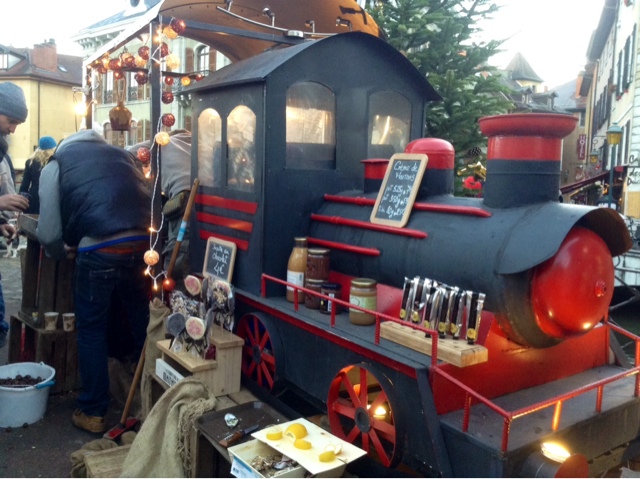
With Christmas around the corner, a Christmas market sprang up and lights festooned the bridges and canals, giving Annecy a suitably festive feel. I was hoping it would snow, but the weather was not obliging and December was mostly oddly warm for the time of year.  
As many of my friends were leaving over the Christmas break, I had a leaving get together/Christmas party at my house, and made a ridiculous amount of food. I also made my first Bûche de Noël which didn't turn out too disastrous! Although it tasted a bit eggy, once the ganache was applied it actually tasted fine! My favourite part is making the little meringue mushrooms. 
I was lucky enough to make a brilliant group of friends in Annecy, from all different places in the world, and it was this group of friends that really made my stay in Annecy unforgettable. 
The end of the year also brought with it the end of classes for two weeks for the Christmas break, and the school had an epic Christmas party. Not only did all the teachers sing us traditional french carols (with one of them playing the piano accordion no less!) but we had all the students together in one room, and tonnes of traditional french Christmas food cooked by the teachers themselves! One of my Polish friends had just come back from visiting her family and brought with her plum floured vodka - it was actually very nice and the only time I've enjoyed such a strong spirit! 
Before I knew it Yannick and Necia were back again to spend the Christmas holidays with me. Our first Christmas together out of New Zealand, we certainly made it a good one, with grand food plans, and an impressive alcohol stash for the next few weeks - mmmm cider and champagne for Christmas!
I also took my family to the Christmas market, and I finally got to try roasted chestnuts! Children's stories like Brambly Hedge had me dreaming of cosy roaring fires and roasting chestnuts since I was little, but I was in for a disappointment. They had a strange soft texture and reminded me of decomposing mushrooms - I was not impressed.
However there were other highlights to the market that I did enjoy, such as mulled wine!! A specialty of the region, it was perfect once the sun had begun to set and the day turned chilly. 
With so many different stalls offering mulled wine, I felt obliged to try most of them (what a shame) that way I could make a truly informed decision on the best one - and here it is! Only a few euro (you also pay a euro deposit on the glass as well and then get it back when you don't run off with these snazzy Christmas cups) I noticed that as a general rule going for the stall that sold only wines (mulled and otherwise) was markedly improved from the stalls that sold many other different foods and drinks as well. A good tip to keep in mind for next time!
And then suddenly it was Christmas day! Forgoing trees or presents this year, we made up for it with copious amounts of good Christmas food (and some fairy lights in my room for mood lighting - I couldn't resist) feeling like we were truly continuing on the traditions we made our Dad's roast chicken recipe with roasted vegetables (which turned out excellent) and my version of pavlova, topped with berry couli (and did I mention the champagne?) - It was a perfect mix of the old and new, and it felt like we were beginning our own traditions. 
A small family Christmas in Europe, although I always miss being home when Christmas comes around, I can easily say that this one was the best yet in my Europe travels!
A strange family resemblance emerges when we are put near good food or wine....

Sunday, April 3, 2016

Annecy: A trip through history

Having lived in Annecy for a few months, it felt remiss of me not to visit the interesting historical landmarks of this little town. It helped that on the first Sunday of every month the sites were free. The Chateau d'Annecy dominates the skyline above Annecy, one of my favorite views was sitting at the lake and looking back at the town at sunset, when the Chateau was turned pink by the setting sun, and the mountains on fire behind it. 
The chateau was originally built in the 12th century, but continuously added to until sometime in the 16th, leaving it a patchwork of styles. Once home to the Counts of Genevre, it was eventually abandoned in the 1700s due to a series of fires.
The castle was later restored as a barracks until the mid 1900s where it was bought by the town of Annecy and fully restored. The views from the hill it stands on of the town below are breathtaking. I once again had that 'I'm living in France!' moment when I saw this.
Exploring the castle together with my new friends. 
The castle itself held various museum displays, but my favourite one was this painting showing medieval Annecy - it was stunning to see how little had changed. 
I was greatly amused by this lavatory (the hole went straight down the cliff-side and you could see down far far below) and my friends and I discussed the likelihood of spiders crawling up it.
Our second stop was to the Palais de l'Isle, probably considered the heart of Annecy old town (not to mention the most photographed) built in the 12th century, the island was once the only passage over the river and therefore had a toll attached for those wishing to cross (typically medieval mentalities!)
The island later functioned as a prison, a court house and even a minting house. Later in WWII it was used by the French resistance, and then used for Prisoners of War. The bars on the windows certainly looked immovable. 
The medieval kitchen, adorably quaint and with a view from the window straight down to the canal and the medieval streets of Annecy, it was easy to imagine the bustle of medieval life passing this window by as someone chopped and cooked for the prisoners and guards.