Sunday, August 16, 2015

The Culinary Camping Connoisseur #7: Boeuf Haché entre Bap (avec Toppings)


Boeuf Haché entre Bap avec Toppings (serves three) 

Ingrediants
1 white onion
 3 white burger buns (sesame sead or poppyseed buns could be used as a change) 
Lettuce
One large tomato 
Dijon mustard
3 slices of Emmental cheese 

Mince 
500g beef mince meat 
Salt
Pepper
1 egg
Breadcrumbs
Basil 
Garlic 

Equipment 
Cutting board
Knife
Frying pan
Large bowl for preparing patties 
Gas cooker 
Large wooden or plastic spoon for flipping 

Method 
1. Prepare the ingrediants, dice up your onion, slice tomato and finely chop garlic. Wash lettuce if necessary 

2. Prepare the mince by placing meat into a large bowl, crack lots of pepper, salt and basil in (depending how herby you want it). Crack in an egg and work it through meat, add breadcrumbs to get a texture that sticks together without being slimy and obviously eggy. Add in chopped garlic and work it evenly through.

3. Fry onions on a medium heat until golden, set aside.

4. Drizzle some oil into the pan on a medium-high heat. Once hot, place the shaped mince patties in the pan. Sear on both sides and then lower the temperature to cook through. Cook to your liking.

5. While the patties are cooking, prepare the buns. Slit them sideways but not all the way through so your burger won't fall apart and spill hot juices on your fingers. 
Spread mustard on bread if using, then place lettuce, tomato and onions on the open 'lid'. 

6. When the patties only have a few more minutes until they are done, place cheese slices on top and let them melt to your satisfaction. 

Take our the patties and place them on the bottom of the bun. Push bottom towards the top to connect the burger without losing all your ingrediants. Now it is ready to eat. 

Serve with a nice light Czech beer, such as Pilsner Urquell


The Culinary Camping Connoisseur #6 : Caprese Salad

Caprese Salad (serves three) 

This dish can be an entree or main depending on how hungry you are. To bulk it up you could have it on slices of bread, or with a rocket salad. 
This is a great easy dish if you don't have a gas cooker, don't want to cook or unable to do so due to raging wildlife (e.g. Wasps). 

Ingrediants
1 punnet Cherry tomatoes 
2 large balls of Bufala mozzarella 
Extra Virgin olive oil
Balsamic vinegar
Salt
Pepper
Basil (fresh if possible) 


Equipment 
Chopping board
Knife 


Method
1. Chop your tomatoes roughly, cut thick slices of mozzarella 

2. Sprinkle tomato and mozzarella with salt, pepper and basil (if dried) 

3. Place your mozzarella slab on the bottom, place tomatoes as wanted on top

4. Drizzle olive oil and vinegar to taste, add fresh basil if using

Note: if using bread rounds, place mozzarella directly on bread these first then follow above steps

Serve with a light prosecco 

Saturday, August 15, 2015

Our Father, Who art in Heaven, Connery be Thy Name

On our way out of the Rhine Valley, Yannick suggested we take a small detour to an old abbey that featured in a number of movies due to its beautiful architecture and pious atmosphere. We soon learned it had in fact been the setting for the Sean Connery movie 'The Name of the Rose' which none of us had ever seen but had the sudden burning desire to do so, if only to hear Sean Connery's distinctive voice acting priestly. 

The abbey itself was a rather large and impressive complex, from wine presses to cellars, this monastic retreat had it all. It at one point had the largest vineyard in medieval Europe, producing a variety of wines. The other brilliant thing was that although the car park was crowded, the buildings were very quiet, and we wandered peacefully. 

Founded in 1136, the abbey had a long and interesting history. Abandoned during the Thirty years war, returned to, then dissolved with the French Revolution, this complex has served as a prison, an insane asylum and eventually the public site it is today. 
This desolate room was difficult to imagine as the home to many as once upon a time it had served as the dormitory. 

Returing to our car we caught sight of a number of extremely fancy cars that made me feel like we has just turned up to a prestigious party underdressed. Where all the rich owners of said cars were we weren't sure, but we assumed they were poshly getting sloshed at the wine tastings offered. 

Our next stop was Heidelburg, a pretty town with a long history. Starting out as a Roman camp, it developed into a small Medieval village first mentioned in 769 AD, called Bergheim (meaning, inventively, mountain town) until the 12th century when a local monastery record mentions it as Heidelburg. Another interesting note in its history was that Martin Luther visited here to defend his 95 theses. 

We made the unfortunate decision to eat lunch here which proved to be the culmination of our culinarily mishaps (who knew white cheese meant sour cream?) we decided to mainly stay away from German food after that. Yannick did however make up for this slightly with a rather Rum-filled hot chocolate.

Heidelburg castle dominated the skyline and was the main reason for the plethora of tourists. Built sometime before 1214 it suffered numerous damages including two lighting strikes (what happened to lightening never strikes twice!) and a number of fires leaving it constantly unfinished and often partially ruined. We did not go in as it was overpriced, but we enjoyed the outside, and the tower especially. The gardens were very pleasant too - a nice place for a picnic if you have the energy for the steep walk up with picnic items.


Friday, August 14, 2015

The Culinary Camping Connoisseur 5#: Bruschetta

Bruschetta (serves 3)

Ingrediants
Cherry tomatoes
Salt
Pepper 
Basil
Olive oil 
Flat white baguette or ciabatta 
Garlic 

Equipment 
Frying pan
Gas cooker
Wooden or plastic spoon 
Cutting board
Knife 

Method 
1. prepare your ingredients, slice tomatoes and bread ans thinly as possible and chop garlic well
2. cook garlic in olive oil until aromatic. 

3. Place your bread slices in the pan with the Garlic and a generous dash of oil. Continue to turn and add oil until lightly golden. Remove from pan.
4. Add your tomatoes to the pan on medium heat with olive oil, pepper, salt and basil. Fry until semi-cooked.

5. Place the tomatoes on-top of your bread with a dash of Olive oil.


Note; If possible replace dried Basil for fresh (in which case garnish at the end) and add a sprinkle of mozzarella, rocket and lemon juice to give it a fresh twist.

Thursday, August 13, 2015

The Rhine: Voyage Through the Valley of the Hillside Pirates

Being in Germany meant trying all things German (but especially beer). You can see here my first foray into German beer - unfortunately I was actually rather disappointed. For all that the Germans are known to love beer and have their famous Oktoberfest, I found it very forgetable. Not much taste and slightly watery. 

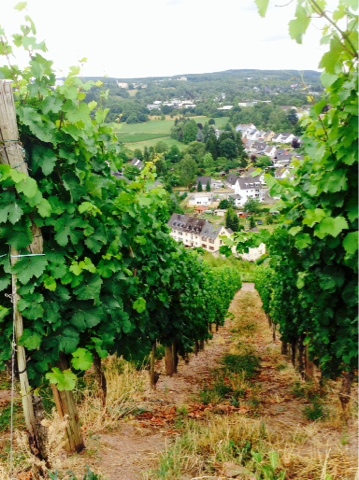
The Rhine valley is famous for medieval villages, vineyards down swooping hills, rocky outcrops, rugged castles, and of course, the inexorable wending of the river. 
Having a car is a great way to get around this region as I can't imagine buses would be very easy or pleasant, and this way we could pick and choose from a multitude of villages. The one downside of having a car is that the villages are of course on both sides of the river, and there is no bridge. But don't panic yet! There are many little car ferries crossing constantly at set points on the river, and only cost a few Euro. 

Our first stop on our pleasant drive was in the Moselle valley on the way to the Rhine. Traben-Trarbach was once the site of two villages across the river from another that were agglomerated into one in 1904 (I couldn't help but wonder how the residents themselves felt about this). A pretty bridge straddled the river between the two villages creating a picturesque scene. 
Unfortunately three major fires meant that this village no longer had a medieval centre, but it was pretty nonetheless. We were on a mission for bread for a picnic lunch, and thought we were in luck when we spotted a bakery. The bread that we purchased however reminded me of Hagrid's rock cakes - concrete. 

The Rhine valley was once rife was river pirates and barons who would build castles on the river and exort tolls from passerbys. This meant that at almost every new bend in the river, a castle greeted our eyes.

Bacharach was hands down my favourite town in the Rhine valley, and in fact in all of Germany. I do think a large part of this was because we went at dusk - the crowds disappeared leaving quiet cobblestone streets, half timbered houses glowing from warm street lights and mysterious dim alleys. I am sure had we seen other towns in the Rhine during the evening, I might have been similarly blown away. 
One of the most interesting things from Bacharach was the Wernerkapelle. In 1287 the body of sixteen year old Werner of Oberwesel was found murdered. Due to his unexplained death, the Christian community of Bacharach accused the Jews of murdering him for Passover observances. This accusation was called a 'Blood Libel' and was extremely popular at this point in time - indeed it is one of the major reasons for European persecution against Jews.
 As usual, the Christians had if horribly wrong considering the Torah expressly forbids murder. Regardless of this glaring flaw in their logic, the alleged murder led to an anti-semantic mob that violently wiped out the Jewish communities of this region. 
Werner was buried at this site and became venerated as a martyr - stories of miracles soon began to circulate from his burial place. This led to the expansion of the original church on the site of Werners burial, becoming known as St. Werners chapel which still stands here today. Although originally it was to be expanded into a larger church, a lack of funds and decline in veneration of martyrs meant this church was never finished. 
In happier news, we also found some wild berries growing by the church which we thought might be raspberries or blackberries, but decided not to test our theory. 


As everyone knows, Germany is the home of pretzels, or as they are called n Germany, Brezal! I wonder why we changed it pretzel? 
The exact origins of this tasty bread are hazy, whether they came from Germany, Italy or France seems unsure as there are many different legends. It does however probably originate from the 7th century AD as was invented by the monasteries. And nowadays it makes a damn good snack! 

Saturday, August 8, 2015

Arrrrrg and Other Tales

Our first stop into Germany was at a town called Aarchen, or as we affectionately named it, "arrrrg". We stopped here for two reasons, an impressive cathedral and a speciality food. The cathedral proved to be closed for renovations disappointingly. Have a picture of squeezed fish instead.

The speciality food did not disappoint. A type of gingerbread biscuit called Printen, we found a bakery off the square selling bags of the stuff. 

Printen  it turned out, originally probably came from Dinant in Belgium, and it wasn't until copper producing craftsmen came to Aarchen in the 15th century (bringing their recipe with them) that it became a speciality here. Funnily enough due to the honey and various spices these biscuits contained, they were originally sold at pharmacies for medical properties. Nowadays you can choose from original, chocolate and nut, or a faintly aniseed glaze. All are very nice (we bought a mixed packet so as to try all the flavours. Greedy? Never!) but original was my favourite. 

Our next stop was to pass through Cologne for its colossal Cathedral: the biggest Gothic Cathedral in Northern Europe in fact. Named Germany's most visited landmark with 20,000 people a day coming to see it, it dwarfed the crowds below. Work on this monolith began in 1248, but stopped in 1473 and it wasn't completed until 1880. In the 1100s important artefacts such as relics of the Three Kings (who followed the star to see baby Jesus) were brought to Cologne, creating a demand for a suitable area to house such artefacts. Thus the cathedral plans began.
 During World War II, this magnificent cathedral suffered fourteen hits from allied bombing and was badly damaged. Even so, it remained standing in an otherwise completely flattened city.

After our brief jaunt around Cologne, we headed for a site far older. Trier was home to a number of Roman sites, and as such had piqued our interest. The Porta Nigra arrested our eyes as soon as we entered the town. Looming and bleak in the rain, it looked like something out of Lord of the Rings (and indeed I couldn't stop myself whispering a number of times "the Black Gate of Mordor!!" in what I hoped was a passable Gollum impression)

Serving as an entrance to the town, the Porta Nigra was built between 186 and 200 AD. For reasons unknown, it was never finished, but formed an impressive gate nonetheless. Unlike many of the other gates of this city that were slowly torn down for building materials after the end of the Roman era, this gate was turned into a church in the 11th century thus keeping it preserved. Additions were made to turn this structure into a working church, but in 1804 Napoleon ordered the gate to be returned to its orginal Roman state and the church was dissolved. Thus the gate as we see it today is unchanged since Napoleans reconstruction.   

As always when wandering Europe, it was possible to see these little signs engraved on the ground outside houses, marking the last living place of the Jews who were deported and murdered during the Holocaust. 

My favourite Roman site in Trier turned out to be the Roman Baths. Surprisingly cheap at 3 euro per person, this structure would have once been monumental - the largest bath complex this side of the Alps in fact. Beneath the innocent facade of grass lay a network of impressive and winding tunnels that were just eerie enough to be exciting without being claustrophobic. 

Built by Emperor Constantius I beginning sometime before 300, they were never completed. However they were reused in as a barracks and then later, a Medieval castle.

Tired out from our historical meanderings, we decided to take a lunch break before continuing. We came across a restaurant serving recipes from the famous chef Marcus Gavius Apicius who cooked for the Roman emperor Tiberius. Unfortunately we couldn't get the mains as they were a dinner only special, but we decided to try some interesting sounding entrees and drinks. Yannick chose some rather delicous herby sausages, and Necia and I picked the barley and pork soup. Unfortunately it wasn't anything special, although it was interesting to try Barley, and it had a nice thick texture, the pork made me afraid it had come from a can (and there was an awful moment where I felt quite sure it was actually tinned tuna) and the soup itself was strangely enough, overly sweet. The Roman drink was rather nice however, consisting of honey and wine and strong herbs it was unlike anything I had tried before. Feeling somewhat hungry still, we topped ourselves up with a chocolate twist from a nearby bakery. 

We stopped for a quick look at the Roman arena, but it was in fact rather disappointing. The seats were long gone (although the grass was still shaped as if the seats could be resting underneath strangely enough) and there was little to see. A mock sword fight between 'Romans' did little to improve the site. 

Feeling not quite replete still, we decided to get wifi and a Dame Blanche at a nearby restaurant. There were some amusing comic icons that we passed both on the street and in the restaurant. 

To end our day and work of our double dessert lunch, we headed up to the hills for a stroll among vineyards and a view of the town. 


Thursday, August 6, 2015

The Culinary Camping Connoisseur #4 Gung-Ho Galettes and Corking Crepes


Gung-Ho Galettes and Corking Crepes (serves four)

Ingredients 

Galette
2 eggs
2 cups of buckwheat flour 
2 cups of milk 
A pinch of salt 

Crepe
2 eggs
2 cups of milk
A pinch of salt
2 cups plain white flour 

Toppings 

Galette
Emmental (or any other melting cheese) 
Prosciuto 
Salt 
Pepper
Dried basil
Lemon juice
Rocket 

Crepe
2 blocks of Dark chocolate
A dash of Prosecco (optional) 
white sugar
1 Lemon 
Strawberries and blackberries 
Speculoos spread 
Speculoos biscuits 


Equipment 
Frying pan
Oil
Large plastic spoon 
Large mixing bowl 
Gas cooker 
Foil 
Pot

Method 
1. Making your Buckwheat batter first, combine all your ingrediants together and whisk briskly until there are no lumps.
Prepare your toppings: slice your cheese, Prosciuto etc.
2. Heat your pan on medium heat with enough oil so that your batter doesn't stick 
3. Pour in enough batter to lightly coat the bottom of your pan. Once the edges of your pancake are curling up slightly, flip with whatever utensils you have available to you
4. Immediately place your cheese slice on one half of your pancake, then your Prosciuto. Next add a crack of pepper, a pinch of salt and a generous shake of dried basil. Squeeze a little lemon juice over the top and then fold pancake in half. 
5. Once cooked, either place in foil to keep hot and repeat the same process, or eat before cooking your next one. When about to eat, garnish with rocket and a dash of lemon juice. 

6. Once you have enjoyed your Galettes, clean your mixing bowl and make your crepe batter following the same instructions as before.
7. Prepare your ingrediants, cut your berries (sprinkle a little sugar over your strawberries to bring out their juice and flavour) crumble your speculoos biscuits etc. Do not melt your chocolate yet however as it will cool to much at this point.

8. Cook each pancake, however this time do not add your ingrediants into the pan and instead place each pancake directly into a foil covered plate (make sure no heat can escape) repeat until you are out of batter. 
9. Keep your pancakes covered in foil, put your element to a very low heat and place your chocolate in a pot. Stir continually and make sure you do not overcook. Once it has melted, add your prosecco (taste testing first of course!) and stir it in well. Take off the heat.
10. Assemble your pancakes with the toppings of your choice (death by chocolate is always recommended).