Tuesday, November 6, 2018

Portugal: Highlights Part III

July 2017

Evora
Yet another well preserved and beautiful medieval town, Evora has its roots back in Roman times, which means it has multiple layers of history to explore!
One of the most impressive ruins is that of the Roman Temple of Evora, which one stumbles across almost by accident if heading for the main square. Popularly known as the Temple of Diana, it was wrongly attributed to the goddess in the 17th century, a myth apparently perpetuated by a priest. It was in fact devoted to the emperor Augustus, and built in the 1st century AD. Used in the 15th century as a medieval slaughter house, it is now a UNESCO world heritage site, and is just one of the awesome things to check out in this town. 
A second must see, is the ossuary (also known as a charnel house) Capela dos Ossos. Not for the squeamish, this chapel contains the remains of about 5,000 people. In the 16th century, a common problem was the lack of space for burying the dead, leading to mass relocation and often transforming the remains into macabre art. 
Three Franciscan monks - who were also later incorporated into the mountain of bones - followed this trend to solve the city's problems, and thus this ossuary was born. Although it may seem strange to us now, people would often request to be buried in these places, as this would increase their remembrance (and thus hopefully the number of prayers for them, speeding them through purgatory). The idea of being dug up and reburied in bits also may seem rather abhorrent to us, but it may not have bothered the medieval psyche so much, as it was believed the soul had left the body, and that disarticulation was inconsequential, as on Judgement day God could reunite the body, no matter how scattered it was. In which case, why not make art with human remains, I suppose? 
How public these charnel houses were is unclear, and probably differs from place to place. However in many of these places, some of the bones have become shiny, as they wear from continuous touch. This at least seems to suggest some reverence or ritual attached to visiting/touching the bones, not unlike saint's relics. It only costs 2 euro to enter (3 if you want to take photos) so is well worth it in my opinion. 
Onto more cheerful surroundings, the huge and beautiful cathedral of Evora is awesome to visit, and its really worth paying to see the cloisters, as they were my favorite part. Built the 13th century (though continually added to until the 18th) this is Portugal's largest cathedral!


Sneak a peak at Evora's Roman Baths, hidden in the Town Hall! It's not really signposted, but well worth a quick look.

Cuba
Leaving Evora behind, we headed here on the recommendation of Lonely Planet, simply for lunch. I have to include it however, because it's one of the best meals we had in Portugal! Taberna do Arrufa. Go there. We had red wine from the amphorae sitting right there in the room, which has been made like that for hundreds of years. Talk about tradition! We had cheeses, a sausage on fire at our table (which we were all too terrified to do anything with until the flames had died), octopus from the oven, the best sweet potato fries of my life, and then chocolate mousse for dessert! The waitress was so obliging that when I couldn't decide on caramel or strawberry chocolate mousse, she brought me half of each. I can't recommend this place enough (and I was so busy eating, of course I forgot to take photos).

Serpa
We only made a brief stop in this town, but it has some crazy old walls (which seem somewhat dangerously balanced in places) and is lovely for a short wander.


Sao Domingos Mine
This abandoned mine was deserted, and felt like something from a wild western. It has a surprisingly long history, having been mined by the Romans. It wasn't closed until 1966, and the smell of sulphur hung in the air as we wandered under the hot summer sun. Luckily its not a long walk (unless you really want to explore everywhere) and you can park pretty close by. Still, water is definitely needed!


Mertola
We stopped on the other side of the river from the town of Mertola for a spot of lunch. Casa Amarela was a lovely location with good views (though it was so hot we sat inside with the air conditioning) and dined on cheeses and meats, a house red, and an insanely good jam chutney that tasted like Christmas, and was somehow perfect with sheep cheese. The food here is simple but delicious, and the red wine so good that we asked to buy a bottle!
Feeling refreshed we decided to explore Mertola, though it was a struggle in the heat of the day, hitting 38 degrees. We enjoyed a wander of the ruins of the Almohad neighborhood from when the city was under Moorish control, and got to peek beneath the ground at roman ruins too!


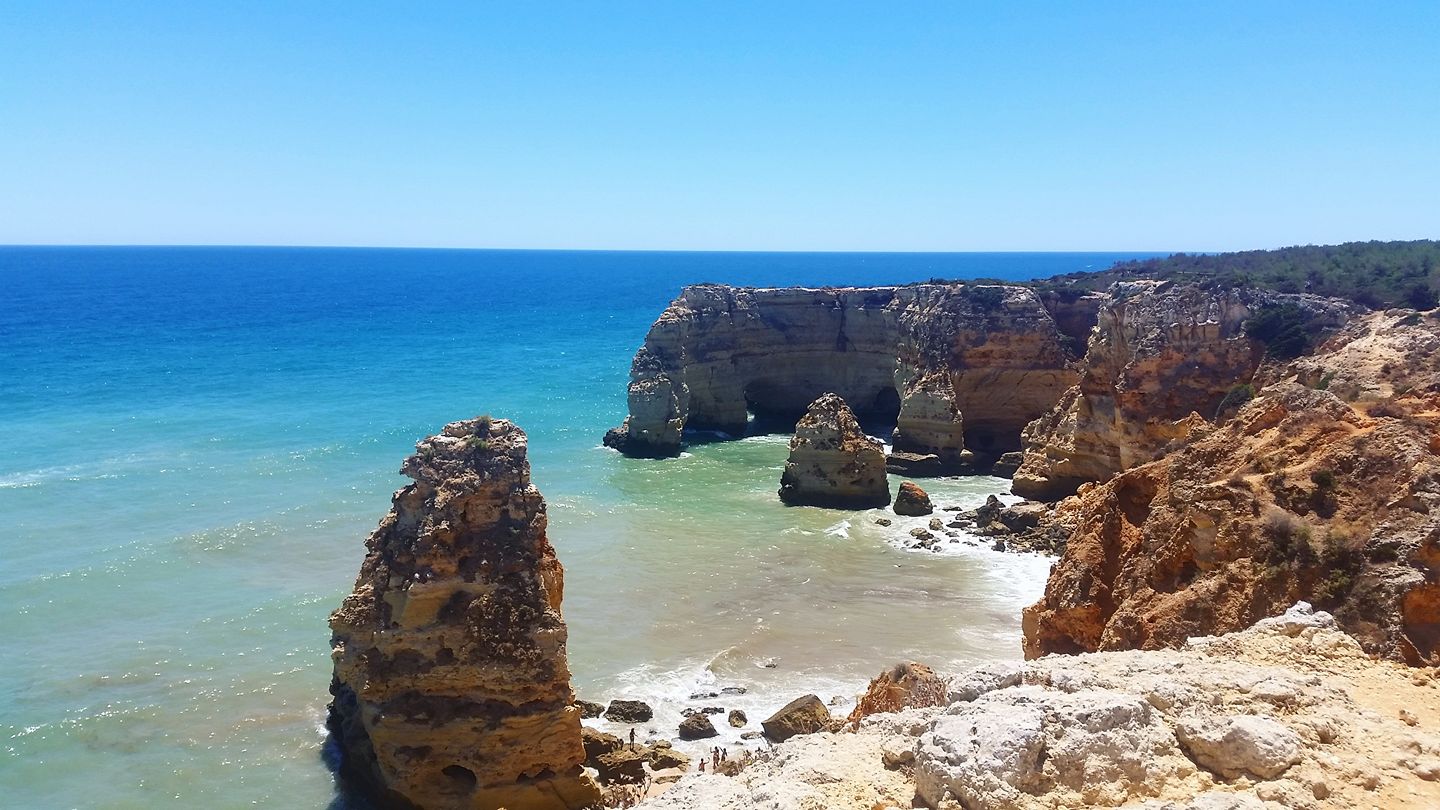
Praia da Marinha
Hitting the coast, the views from the cliffs are stunning from here. Though for swimming, praia do camilo is better suited.


Cape St. Vincent
This cape is the southwesternmost point of Europe, and would have been the last piece of Portugal sailors would have seen before they sailed into the blue unknown.
 Its busier than you would expect, but has beautiful views and dramatic cliffs (Don't fall in, there's no barrier!)


Praia de Galapinhos
This was probably my favourite beach that we went to, though we got a little lost in the scrub on the way down!


Sintra
Sintra itself is a pleasant town to wander, but we went there for the park and national palace of Pena, a whimsical and beautiful palace set in stunning grounds, featuring caves, fountains, forests and waterfalls. It feels like a micro-climate too, because as soon as we entered, the mist dropped in and a very light rain started, providing plenty of atmosphere.


It's all thanks to King Ferdinand II, who had the palace constructed in the 19th century. Clearly someone read too many fantasy books.


Apparently it is actually still used on occasion for state matters by the president, which must be pretty damn cool. Pictures really don't do this place justice, the call of birds, the tendrils of mist hanging through the forest, the paths leading in all directions meaning you feel you can get lost in this strange and beautiful place... It's well worth spending half a day exploring. But go early in the morning, to try and beat the crowds!
We finished off our time in Sintra by popping into Casa Piriquita, to try the local specialty called travesserios (pillows in Portuguese) a pillowlike (hence the name, one supposes) puff pastry filled with almond cream. It sounds simple, but boy is it tasty! Open since 1862, this is the place to try this dessert. Apparently the granddaughter of the owner stumbled upon the old family recipe book and found the recipe within, bringing it to the fame it now holds today (and the recipe remains top secret!). 

Convento dos Capuchos
Although it costs 7 euro to enter this monastery, and it's somewhat off the beaten track, its worth going. It's not popular with tourists, which meant we had the place to ourselves.
Founded in 1560, it housed only eight monks, and must have been freezing in winter, though apparently it was lined with cork to try and insulate it from the cold. The entrance to the monastery is dramatic in itself, with two giant boulders resting against each other, and you walk beneath them.
 It's a stark difference from the building itself, which is dark, cramped and claustrophobic. Segregated away from the outside world, this must have been a hard, harsh life. The monk's cells were tiny, the doorways only reaching to my shoulder, and to enter one had to go in sideways (that's one way to keep the monks from eating too much, I suppose). I felt so out of place in these tiny rooms, it was like something from Alice in Wonderland, where I had grown too large for my surroundings!
Interestingly there seemed to be some on-going archaeological undertakings underway, and some areas were cordoned off. I wonder what the current research is?


Tuesday, October 30, 2018

Portugal: Highlights Part II

June 2017

Amarante
From its description, I expected to fall in love with this town. I didn't, but it was very pretty. The São Gonçalo bridge spans the river to the town, and is one of the famous views of this area. The bridge held off the marauding French in 1809, and the locals are rather smug about it. (I mean, who wouldn't be!)
Crossing the bridge, we stopped off at Confeitaria da Ponte, a bakery overlooking the river, and tried three desserts. Again, they were just too eggy for my liking, but the views were great!
Having had a long day, we managed to find the best campsite ever, in the vines with only one or two other people staying there, and had an excellent evening cooking by our tents.


Lamego 
Lamego had an impressive baroque staircase leading up to a church, something we were beginning to realize was rather common in Portugal. We attempted to visit the castle and the cistern, but both were unfortunately closed. 

Duoro Region
This was one of my favourite areas in Portugal (two guesses why!) and home to Port. We had decided therefore that we would be remiss to not do a Port tasting, and picked Quinta da Roeda. It was smaller than many of the other vineyards, and we were able to choose ourselves what to taste rather than a set menu. 
We chose a rosé, a late harvest bottled vintage, and a ten year tawny, and it was only 12 euro each which I thought was very reasonable. We were lucky enough that a tour bus had just left when we arrived, so we had the place almost to ourselves, and were able to sit very privately around a wine barrel with beautiful views!
The whole area was extremely scenic, and actually reminded me somewhat of the Rhine Valley in Germany. It's definitely worth having a car to explore the area, and I wish we had done more port tastings to compare other brands. Next time!!

Casa de Mateus
One of the things we had developed a taste for in Portugal was a cheap rosé wine called Mateus. We discovered that the Palace of Mateus was open to the public, and thus decided to check it out! Sadly no wine tastings seemed to be on offer, and one could only see the palace by guided tour, so we paid to wander the lavish gardens instead. It's expensive, but worth it!

Trancoso
This walled city was amazing to walk around at night, lit up and atmospheric. Of course, night shots are much more difficult to take than day ones, so we did return for photos the next morning. Its medieval past was clear from the fortified walls and old buildings, and in fact Trancoso was once of great strategic importance to the country. A small word of warning though, for fear of sounding like Professor Trelawney, Beware the Grim! (By which I mean, massive stray black dogs crouched over rubbish bins scaring the crap out of unsuspecting tourists at night). But never mind that, look, pretty flowers!
Monsanto 
This unique village is built into boulders in the mountains, and it's amazing to wander around! Apparently in 1938, it was named the most Portuguese town in Portugal, whatever that may mean. It's a bit of a clamber, but it's worth going to the top where a Templar castle sits, though unfortunately was partially destroyed in the 19th century when the munitions storeroom exploded (why do they always keep explosives in beautiful old buildings!??)
After an amusing stop at a campsite where everyone but us wanted to know where the Bean festival was (it turned out they were looking for the Boom festival, a Rastafarian music festival, not a farmers paradise as I had imagined), we headed for more history.

Idanha-a Velha
This village was awesome, as it had layers of different ruins, and was very scenic. There were no other tourists there, and we had a local man run up to us and ask if we liked cheese! On saying but of course, we were then convinced to buy a sheep cheese which keeps for two weeks at room temperature! It was stinky, but delicious (though it got ever stinkier as time went by). After a good wander along the walls (My brother's favourite pastime) we headed off for the next town on our list.


Castelo de Vide
This lovely town of white-washed walls and red roofs is brilliant for a relaxed day of exploring, slowly making your way up the hill to the castle that dominates the view. The area was settled by the Romans, destroyed by the Vandals, and then conquered by the Moors, before becoming Portuguese in medieval times, with its name changing from Vide, to Castelo de Vide with the construction of the castle in the 1300s. 
All the walking made us hungry, so we made a little stop at Toca do Chocolate, an excellent shop within the town, where we sampled chocolate cake, chocolate mousse, white hot chocolate, and caramel milk hot chocolate... so it was more than a little stop. But it was a great one!

Vila Vicosa
Quite unlike humble Castelo de Vide, this was a town of important buildings, impressive squares, and of course, statues of men on horses. It reminded me a little of Vienna, at least in the central square. Very grand, worth a wander, and full of fancy marble. 
Monoliths on the Outskirts of Evora
Taking a small break from towns, we went in hunt of something far older. The Almendres megalithic settlement (known as Cromlech) is one of the oldest in the world, which is pretty crazy when you're just wandering around it as you like (a far removal from Stonehenge, which you can't really get close to at all). About 100 menhirs stand, and were in use for a very long period of time, from about the 6th century BC. It was very hard to see, but there were also carvings on some of the stones, with lines and circles. Weathering has of course, faded many of these beyond what the human eye is capable of seeing. 

Sunday, October 28, 2018

Portugal: Highlights

June 2017

Before leaving Porto, we first sampled the famous Pastel de nata. It's a very eggy mini custard tart, and sort of reminds me of overdone french toast, somehow in a good way. There's a popularity of eggy custard in many desserts in Portugal which I thought was interesting (though often not to my liking). Supposedly, in medieval times nuns used egg whites to starch their habits, and then had to find a use for all those unused egg yolks; hello many eggy desserts. (In reality, they probably just had too much time on their hands, and many eggs. If bored, bake?) 
Eggs were also used as a currency by the poor, which may also explain their egg-treme popularity. (Or maybe the Portuguese just really really like eggs?) 

Penha
Our first location out of Porto, the views are amazing and the landscape dramatic, with forests and huge boulders covered in moss and ferns, not unlike something from Middle Earth. It's a scenic drive, and worth going to the top to see the church. It was so great I forgot to take photos, so you will just have to go there yourself! 

Bom Jesus do Monte
Another worthy stop, I found this name hilarious, and the views spectacular. It was free which is another bonus, and surprisingly quiet. Maybe other tourists don't like bom jesus, but we thought it was the bomb. Heh.


Guimaraes
This was one of my absolute favourite places in all of Portugal, a medieval town with beautiful architecture, and a festival going on when we arrived! This was the capital of Portugal in the 12th century, and it is commonly said that this is where Portugal was 'born'.


The festival 'Fiera Alfonsina', is a four day event occurring in June, and probably helped me fall in love with the town, considering the atmosphere it gave it. Everyone is dressed in medieval garb, there's stalls selling food, sword fights, music...the town is transformed. My favourite thing was that it wasn't just people walking around, they were acting out little scenes, like women washing their clothes, prostitutes talking to soldiers, and beggars getting shooed away! 
We picked up a local specialty as we left called Toucinho do céu, an almond cake with variations across Portugal, but famous from this town in particular. Amusingly, it translates to Bacon from Heaven, a reference to when it used to be made with a dash of pork fat (nowadays its made with a ridiculous number of eggs instead. No really, sometimes up to 20! I told you they were egg-static for eggs).  


Citania de Briteiros
This archaeological site holds the remains of an Iron Age hill fort, with charming round houses. The site is a lot bigger than I expected, and you could spend ages wandering around if you were so inclined. Interestingly, its history of excavation is also long, dating back to 1874, with on-going digs until 2006. 


Peneda Geres National Park
We decided to head south, to take a break from towns, and make for the beautiful nature instead. Armed with camping supplies from trusty Decathlon, we drove into the huge national park, which is also Portugal's only national park!
We found a ruined castle and climbed to the top. I became momentarily lost on the way back, and realized how terrible my sense of direction was, and my non-existent survival skills. Luckily we then found the car and all was well.
The regional park was amazingly scenic, full of wild goats and horses, and definitely requiring walking shoes and picnics. However we soon discovered supermarkets are very far and few between, so best to bring supplies with you if possible! We ended up having to eat melon filled with port for lunch, because we didn't have anything else to eat. What a shame. *Hic*

Santuário da Senhora da Peneda
This mouthful of a name was an impressively large religious complex, full of interesting architecture and much too enormous for the tiny town around it. (And by around I mean off on one side, because it really was that small). One TripAdvisor review simply said 'very fancy stairway architecture', which, well, I can't really argue with. 

Lindoso 
A peculiarity of this area were stone granaries, that at first I thought were creepy tombs, because of the crosses. They, and a castle were the highlight of this little town. Known as Espigueiros, these granaries were mainly used in the 18th and 19th centuries to store corn. They were built off the ground to keep the food safe from rats, and some are still in use today.


Saturday, October 27, 2018

Portugal: Porto

June 2017

Portugal was a country I had never really considered going to, until my brother said hey why not Portugal?
Well, why not?
I didn't know very much about the country, except that tourists often think they speak Spanish, which is probably very offensive, considering they have their own language, complex history, and are in fact considered one of the oldest states in the entirety of Europe, having been constantly settled (without shifting borders) since prehistory.
We decided to rent a car, to see as much of this varied country as we could, considering it's known for everything from city life, to beaches, to mountains. The landscape is varied depending on which of the seven main regions you are in, and although we unfortunately didn't end up having enough time to see much of the coast, we covered a lot of other beautiful areas!

Porto
We landed in Porto, home to the famous alcoholic beverage port, and a historic city in its own right. The architecture is very particular, with brightly colored houses and terracotta roofs. The Duoro river intersects the town, and is forded by dramatic bridges. Strangely enough, I didn't love Porto, even though I really wanted to. It would be the rest of Portugal that I would really fall in love with. In saying that, there were a number of things in this city that I really did enjoy!


Porto is Portugal's second largest city (Lisbon being the largest, which would be our last stop on our trip), and has a long history with records dating back to Roman times (and likely older).

One of the first places we checked out was Capela das Almas, cheerfully called the Chapel of Souls; this church is adorned with the lives of saints on blue and white tiles, a style dating to the 18th century, but in this case created in a 20th century refurbishment. It reminded me of delftware, a bright blue and white pottery from Delft in the Netherlands, and was a pleasant change from the dark stone churches one usually sees. This artistic style is dotted around the city, and super worth checking out in other locations, especially the train station!

Our next stop had my inner fan girl squealing, Livraria Lello was the bookshop that inspired J.K. Rowling's description of Flourish and Blotts, the magical bookstore from Harry Potter. You bet I got a selfie. Fair warning though, its ridiculously busy, so don't expect the usual place of tranquility and rest that bookstores offer. There is also a small fee to enter (5 euro).
We also popped into the museum of Photography, housed in an old prison, and completely free! Just watch out for the women's toilets, which have very rusty locks on the stalls, leading to me slicing open my hand and bleeding everywhere. The poor security guard then kindly disinfected and wrapped my hand up, panicking somewhat as he repeatedly told me "I don't know what I'm doing!" He seemed to do a good job though. Aside from the incident, the prison has some lovely exhibitions.

A trip to Porto wouldn't be complete without sampling its culinary delights of course, both food and drink! We stopped at a lovely little Deli called Mercearia das Flores, which also served tapas. I then proceeded to eat the best (and, alright, my first portion of) fried sheep cheese in olive oil, honey and thyme ever.  I will be back for you one day, glorious cheese.

Porto being the birthplace of Port, we were of course obligated to take a tour of one of the city's many Port Houses. We chose Calem, as it seemed to be reasonably priced (12 euro each), and had good reviews. I would highly recommend it, as it included not only an awesome tour of the factory and the process port goes through to be made, but also a tasting of a white Port, and a tawny. Both were delicious, though the tawny was my favourite! We bought a bottle of Ruby at the store however, as it was the third type we didn't get to try in the tasting.
 Before Porto, I didn't even know that there were different types of Port, so to learn about these, and also the history was very interesting. Funnily enough, its in part due to the English that Port came about at all. The Portuguese wine did not survive the sea journey to England well, therefore to combat this, the wine was fortified (initially by sailors adding brandy to try and make it taste better) and thus aged better, surviving the journey and becoming popular in its own right.

Tuesday, July 31, 2018

The Isle of Harris

May 2017

The next morning I was off to the nearby island of Harris, which proved a disaster as it was a Sunday. I was told there were two buses running to the ferry, but then neither of them showed up. It turned out they didn't run until July, which was very helpful as it was currently May.
I had started talking to a french couple at the bus stop that were also attempting to get to Harris, so we thought we could try all hitchhiking together to the ferry, but there were almost no cars about so this proved unfruitful.
We then hurried back to the information desk, and they informed us there was another bus which would make it just in time for the one ferry running that day, so off we went!
The nice french couple who didn't really talk much and I couldn't work out if they wanted me to go away or not then bought me beers on the ferry, so I decided they probably thought I was alright.
They were winging it even more than me and had no hostel booked, so I suggested they tried mine which I had booked in advance, it was called the Backpackers Stop, and had good reviews. This proved successful, the hostel owner was nice enough though extremely stressed about everything (I think she may have been in the wrong profession if new bookings make you panic) however free breakfast of eggs from her hens, butter, bread, cereal and milk was lovely. The town of Tarbert where the ferry dropped us was rather cute too, though small enough to walk through in five minutes.


Feeling rather stressed from the running around and panicking, I was exhausted so decided to stay the rest of the evening at the hostel and start bright and early in the morning.  I looked at the bus timetable before bed, to find it was genuinely the most confusing and horrible thing I have ever looked at (even the hostel owner didn't understand it) but I finally worked out a bus to take - there was only about one a day actually running - and it turned out the french couple were taking the same (no surprises there as it seemed to be the only bus actually running on a Monday, as we had failed to ring up three days before and book a bus to run.... funny that). All the shops were closed, but luckily there was a free box of food left from previous tourists, so I was able to snag a box of instant noodles which were rather gross, but hey, food is food!

The next morning we took the bus to as close as we could to Luskentyre beach, and then walked an hour the rest of the way alongside the french couple (who's name I have quite honestly forgotten, and forgot an hour after meeting them. oops.) The walk was very pleasant and quiet, it was a brisk day but the sun was shining, so I couldn't ask for more.


After all the trials to get there, the beach was absolutely worth it. White sand, pale blue water, it looked like a pacific island, only the temperature of the water was not reflective of this sadly!!


It was icy cold and at times started to rain, so I was well wrapped up in a bright yellow lighthouse style anorak.


Realizing there was no way to make it back in time for the only bus back to the hostel that day, we tried our hand at hitchhiking yet again. Luckily this time a camper van containing a friendly elderly french couple picked us up and took us back to the bus stop so we made it in time! The bus was actually a great experience in itself, as it took us past some amazing scenery! We stopped off at a tiny port town with nothing but a pier and a fish and chip van, (we were starving by this point) and had hot chips and calamari while we waited for the next bus to come along. The next one was a mini bus, and had a CD of Scottish music playing! It was all very enjoyable.
It was late afternoon by the time we all arrived back, and the french couple quickly disappeared so I decided to go on a hike through the hills and have an adventure.


The scenery was stunning, and I had it all to myself without another person in sight. My only company were confused looking sheep, and abandoned houses.


I arrived back from my hike about six, exhausted from yet another day of adventures.


The couple had made way too much spaghetti bolognese, so they offered me some for dinner, which saved me from eating more instant pot noodles happily! We shared a nice chat, a truly terrible bottle of cheap red wine, and they gave me their email, should I ever find myself in the Antibes. Overall a successful day! I headed off to bed, knowing my ferry was the next morning back to Skye.

My two hour ferry experience the next day was interesting to say the least, as I ended up sitting next to a home-schooled kid who must have been about 15 from Harris, who had extremely long hair, and proceeded to talk to me the whole way about his katana, dry-stone walling, and his extra tooth. I was only mildly traumatized.
Arriving back in Portree was rather nice, coming back to somewhere familiar. I popped to the supermarket to grab some food and a bottle of wine (because that's the best way to make friends in hostels I have discovered). I met some nice German girls in my dorm, and it turns out one of them was going to New Zealand the next February for a vet placement, in -of all places - Orewa! Basically where I grew up! I was very excited and gave her many suggestions of things to do. I met up with them in the living room at dinner, as well as with Ollie who was still there, so we all ended up playing a game of good-natured Trivial Pursuit over wine. I won and was only slightly smug.
The next day I headed down to Edinburgh, and onto my house-sit in Sheffield.

Wednesday, July 25, 2018

The Isle of Skye

May 2017

When you mention the Isle of Skye, you'll often hear about the swarms of midges, the lack of public transport, the rain. It's all true, of course. However the friendliness of the people, the stunning landscapes and the picturesque towns all make up for it.
I arrived in the afternoon at the main village, Portree. The bright houses on the water front had me instantly falling in love, though it was such a tiny place I couldn't believe it was the largest settlement on the island!
Apparently Portree was once called Kiltraglen (A much more dramatic sounding name in my opinion) but when James V arrived in 1540 and convinced the islanders to side with him, the name was changed to some unpronounceable Gaelic which meant Kings Port, which eventually become Portree. (I continued calling it poor-tree in my head regardless).


Island life is always different from the mainland, and the isle of Skye was no exception. Search and Rescue sniffer dogs were commonplace, for all the lost hikers (did I mention the entire island aside from Portree had no cellphone reception?) Buses were a nightmare, but ones that did run often did so on request, and would pick up and drop locals to where they wanted to go specifically.
The bus driver that had driven me all the way from Glasgow to Skye had been a friendly middle-aged chap with a broad Scottish accent. I had asked him for recommendations on what to see as he was a Skye local, and after a few hours of chatting he offered to show me a bit of the island the next day, seeing as public transport was so shocking.
This was more like the travelling encounters I had been told of by my parents in the 70s! After talking to the hostel owner, it turned out most travelers still hitchhiked around the island, so I was in good company.
There were two hostels in Portree, Portree independant hostel was meant to be the best (and it's cheerful yellow walls certainly stood out) however this also meant it was unfortunately booked out, so I made do with the YHA instead. The hostel showers were cold, but aside from this it was a nice place, with comfy beds and a nice kitchen.
The next morning I met up with the friendly bus driver (who's name I never did catch) and we headed for the fairy pools, one of Skye's prettiest places, but unreachable by public transport.


These naturally clear pools were just stunning, in the middle of  fields and mountains, the grass lush and green (from all the rain) and surrounded by perpetual fog, I felt like I was in the lonely mountain, and Smaug would emerge at any moment!


 The pools were gorgeous, but far too cold to swim in (or I just wasn't brave enough!)


Heading off to the outter edges of Skye, I thought I would be blown away it was so insanely windy! Neist point was beautifully picturesque, with a lighthouse right at the very edge, before land gave way to endless ocean. It's sort of easy to see how people thought you might fall off the edge of the world if you kept sailing. Sunsets here must be incredible.


I then stopped off at the old bridge which was lovely and scenic, and apparently had once been the main road into Skye!


Hearing everything from a local was so unique and ultimately more meaningful than simply travelling alone or looking at guide books. For instance, one of the most common views in Skye is of two flat topped hills against the sky-line; these are known by locals as MacLeod's tables, and harks back to a legend where MacLeod wanted to show the other clans how powerful he was, so feasted with all his men on top of the hill to show his power, and the name stuck.
 I also enjoyed more modern tales of what people get up to in Skye,  including some local lads who get moonshine whiskey sent over by one of their friend's from Ireland, but since its illegal they send it over in petrol cans, and how one fine summer day upon drinking said illegal moonshine, some of them decided to finally do something with the old van that had been sitting in their garden for goodness knows how long, and used their shiny new digger to dig a hole, lift the car into the whole, and bury it, thus destroying it rather soundly. Only to wake up the next morning and realise they'd buried the new work truck instead of the old wreck... yet another reason why people shouldn't play with machinery and alcohol! However my favourite was the same unnamed friend (I get the sense that there's very little to do on Skye if you live there as a middle-aged farmer aside from walk and drink) decided to drunkenly paint their kitchen blue, but accidentally used the blue sheep paint which never dries, thus thoroughly ruining the kitchen. I was amused.
Back at the hostel, I made friends with some people in the kitchen while cooking, Manuel from Spain, and Olly from England, so we ate our respective dinners together and had a good chat.
The next morning Manual was taking part in some crazy running race over the mountains, but Olly and I were both planning to hike to the Old Man of Storr that day so decided to explore together, because company is always fun!


The hike wasn't actually too long or strenuous, and it was absolutely worth the climb. I felt like I was in Middle Earth, headed for the Lonely mountain. The atmospheric mist that always seems to hang out in Scotland certainly helped.


We still had half the day left, so we took the next bus, him heading off for another hike, and me to a museum I had read about. The Skye museum of Island Life was small but informative. I don't think I would bother going again, but it was cool to see the preserved thatched cottages once synonymous with Skye. They had peat fires in the hearth, and it was actually a lovely, soothing smell. It was interesting to read about how people had lived here in the past, plus the views on the bus ride were stunning.
 Interestingly, Flora McDonald was buried behind the museum - the famous heroine who helped bonnie prince Charlie escape the government troops after the Jacobite defeat, by dressing him up as an Irish maid, allowing him to escape to France (sometimes truth is stranger than fiction). Whilst waiting for my bus, a friendly local offered me a lift part of the way there, but as that wouldn't really help me, I declined with many thanks. I love how friendly people were though, and clearly (especially since the public transport was so terrible) getting around by hitchhiking is probably still the best way to see the Scottish isles.
The way back to the hostel on the bus gave stunning views once again though I found myself for the thousandth time wishing I had a car.


I enjoyed a sunset walk around the cliffs by the hostel, ready to depart for the isle of Harris in the morning.