Saturday, July 25, 2015

On New Horizons: Land of the Friendly, Home of the Cheese

From Antwerp it was only a skip and a hop to cross the border into the Netherlands. This was extra exciting for me as before this we had been going to new towns (and revisiting some old ones) but until then we hadn't been to any new countries. This felt like the beginning of the real adventure! 

The Netherlands is known for good cheese and good beer. Both are true, but what people don't mention is how kind everyone is!! I can happily say Holland was the friendliest and nicest place I'd ever travelled to, bar Greece which it was probably on par with. 

Our first stop was in the provence of Zeeland, which we had purposefully gone to due to it's roots back home to us. The reason for New Zealand's name is actually not as obvious as it would at first seem; Abel Tasmin sighted New Zealand in 1642, and supposing it was part of the tip of South America, gave it the same name as was held there at the time - Staten Landt. He was never able to set foot on this land however as upon approaching they had an altercation with the Maori natives leading to the deaths of a couple of members of his crew. Naming this place 'Murderers Bay' they sailed away, never to return. By 1645 it was known that this land was in fact its own landmass, and it catographers began to refer to it as 'Nova Zeelandia' - however why it was named after Zeeland appears to be strangely unknown. 

We weren't expecting much and were more going for the name, however we were pleasantly suprised; we stopped in the town of Middelburg where we were met by a network of pretty waterways around the countryside and one of the nicest camp grounds we had been to, quiet, grassy, wifi everywhere, sinks to do dishes and the bathrooms even had toilet paper and soap!! 

We went to the town in the morning and were happy to find a farmers market on. Here we bought bags of berries and fruit, a delicious herb cheese that tasted almost like eating focaccia bread, salami and a lovely dark and nutty bread from a bakery. Best lunch ever. 


Just when we didn't think it could get any better, it did. As we wandered towards the centre of the town carrying our supplies, we began to hear the distinctive clip of horses. Oh dear, we thought, it's more touristy than we expected and there are those annoying horse and carts carrying tourists who charge exorbitant fees of forty euros an hour and smelling terrible as they go by (often leaving little parcels behind too). However the sight that met our eyes was a far different one than expected: set up around the central church was a race track, different horses with riders dressed in traditional garb galloped by, snatching rings hanging from banners above their heads (you can just see the tool used for this in the woman's hand pictured below) and flinging them on the ground -it seemed to be a score thing of how many rings you could flick off. 


After our unexpectedly enjoyable morning, we set off upwards heading for an area called Kinderdijk. While this may sound like your typical difficult-to-pronounce Dutch name, it had a History. Long before the windmills were built, in 1471 the Saint Elizabeth Flood swept across this area. After the storm was over, someone went to see what damage had been done and while doing so, spotted a cradle floating in the distance. As he drew closer, he noticed a cat in the cradle trying to keep any water from getting in by jumping from side to side of the cradle to keep it in balance. The baby was kept dry and safe, and thus the name Kinderdijk (meaning child's dyke) arose, and with it the English folktale of "the cat and the cradle". 
The windmills themselves came much later, in 1740 19 of these majestic buildings were erected to keep the river from flooding again, and a couple of them are still used to this day (although diesel pumping stations have taken over their job of draining the river). 

There were many tourists on the walking track but if we wandered out a little past the first few windmills the crowds evaporated. Many people were biking and stopping for picnics which seemed like a nice idea as it was a boiling hot day for once - I enjoyed the sunshine as we walked. Yannick took pictures of bees. Overall it was a good day. 

Wednesday, July 22, 2015

Antwerp: The Curious Case of the Stunted Beds - or: Don't Eat Herring

I knew nothing about Antwerp, and so had no expectations upon arrival.  Perhaps because of this I was pleasantly suprised by our trip and it quickly became one of my favourite cities in Belgium. It was easily walkable and not as overwhelmingly large as some of the other cities we had experienced. The buildings were also very attractive, it had a brilliant museum, good food and nice drinks. What more could one want!? 

The strange statue we came across in central square made me curious of its origins. It depicted a soldier about to throw a severed hand with a fountain of water expelling from it to signify blood pumping. A fallen giant lay at his feet, a great waterfall of water graphically depicting the blood streaming from his headless neck. If was rather gruesome,and also rather awesome! 
The story of its orgins went something like this: Once, long ago, the river Schneldt was guarded by the giant Antigoon from Antwerp, who extracted a toll from passing merchants using the river to transport their goods- if they didn't pay he cut off their hands and threw them in the river. Fed up with this, a heroic Roman soldier called Brabo fought the giant, cutting off his hand and throwing it in the river, and then cutting off his head for good measure. 

The weather wasn't the most wonderful as usual, so we made the best of it and enjoyed a few pubs and other indoor enjoyments. This place was called the Pelgrom, and consisted of series of winding 15th century cellars turned into a pub, lit only by candles and finished with old wooden tables and long benches. The atmosphere was amazing and I would love to go back. The other interesting quirk it had was seemingly no front counter to pay or order at; after a little while a waiter simply appeared, took our order and received payment at our table. 

Museums were as usual expensive, so we decided to pick the best sounding one. The Plantin Mortetus museum was our choice: focusing on the life of Christopher Plantin and his son in law Jan Mortetus. The special thing about this museum was it was their actual house of residence in the 16th century (and everything inside is perfectly preserved and original) and it also served as their printing press company.

Their printing press work stations were truly impressive, they had an industrial room full of printing presses (this was in fact the first industrial scale company of printing presses in Europe) reading rooms to check for any mistakes in the printed papers, a shop front room full of notes and receipts of purchases and orders, book orders still wrapped in their original wrappers on the shelves and much more. 

Plantin Moretus also holds the two oldest printing presses in Europe, one of which I have photographed here. 

The living quarters above were also very interesting to see. This was an entertaining room, which would have been full of guests and parties. This strange instrument featured below is a type of piano, however the keys at the front are for women, and to be played at the same time were the keys to the side, to be played by their daughter. There are only 4 of these left in the world which made it quite remarkable. 

My favourite part of exploring this museum was our run-in with one of the security gaurds. As we wandered from room to room, she noticed we didn't have the audio guides like most other people, so gave us an impromtue tour instead! She was a wealth of knowledge and obviously very eager to share it with people which was nice. Her English was pretty decent too and she tried impressively hard. The only hitch was when she was trying to explain a sweet smelling vegetable that was cut up and put in the beds to stop them smelling in medieval times, which she hopefully had called 'vinkel?' And we couldn't work out what she was talking about.
 She also solved the longstanding mystery of tiny medieval beds for me - I had always wondered why even kings and queens had rather wide but always rather short beds. It turns out the type of food they ate (think pickled herring) gave then wicked indigestion so to combat this they didn't lie down to sleep in bed, but slept sitting upright against the headboard thus they didn't need the extra legroom we use today! (The moral of the story is pickled herring should never be consumed) 

Their private library was beautiful, arranged by size and full of ancient books. 

As we wandered out and down the street to scope out some more chocolate shops, we noticed a small bakery with the line out the door. Deciding there must be such a large line for a reason, we decided to take a look. We walked away with a little biscuit hand in representation of Brabo, and a delicious almond cake. 

It was so amazing we went back the next day for delicious apple strudel and a cherry pastry. It just shows its worth trusting your instincts especially when it comes to food!

We then went to see the Bacon house that had once been the butchers guild in the 1500s. Contrary to the name it did not in fact sell bacon, and looked more like a converted church. However the architecture itself was the reason for its bacon name, here you can see me revelling in the streaky bacon architecture.

We finished our day with a home cooked dinner of lentils and tomato sauce. As we didn't have bowls yet, we made do with eating out of the empty cans, just to be extra classy. 


The Ardennes: Tranquil tree-scapes, Trappists, and treacherous Travel Guides

Tired of cities, we headed down to the Ardennes region of Belgium which was meant to be full of pretty villages, valleys, forests and rivers. There were also meant to be a lot of beautiful houses, castles and other architecture. 

Our first stop was for a town with three nearby windmills, however said windmills failed to appear no matter how hard we looked! We eventually had to give up and comfort ourselves with the likelihood that we would see some in the Netherlands. On our wanderings we did come across this gorgeous Châeau de Carondelet - a 13th century tower house that looked still very much lived in. Unfortunately it was on private property so we couldn't get any closer. 

Dinant was our next stop and this was simply for the beautiful viewpoint. The town itself was full of tourists and traffic so we stopped only for a quick (but worthwhile) photo. 

We stopped for a night in the forgettable Rochefort which was simply a single street town on the road. It had a pretty church and that's about it. 

We also experienced our first Lonely Planet failing with their average pizza recommendation. 

In the morning we head for Lafôret which was a pretty tiny hamlet in itself, however it's draw for us was the wooden bridge that was built using traditional methods every summer. Originally for people accessing their tobacco fields across the river, it is still built every July and taken down at the end of August. For a while I simply examined it from the shore, watching other people cross it. I was distracted by the little wite fluffy dog that wasn't so white after it's adorable mud bath and energetic digging barring us entrance to the bridge. After it waddled off, we attempted to ford the bridge.
It was quite terrifying to walk across especially carrying eletronics as the bridge was held together by a very simple weave of branches at was already beginning to fall apart. I think some of my terror showed on my face for this photo no matter how happy I tried to look. 

Continuing my beer trend! 

Bouillon was a town I was very excited about, mainly because of the famous Bouillon castle. Although records first mention it in the 900s, a castle has probably stood on that spot for far longer. In 1082 Geoffrey of a Bouillon (who was offered the title of King of Jerusalem) inherited it from his Uncle. It was a true medieval castle, full of turrets and drippy dungeons and thick walls and underground tunnels. However Geoffrey eventually sold it to pay for his crusade. 

There were some terrifyingly unrealistic figures dressed up dotted around the castle. My favourite moment was when we were watching the hunting birds and Necia glanced around to see a waxen figure leering at her from the darkness with the beginnings of leprosy spreading across his face. It was terrfiying. 

There was a small museum which was quite interesting, full of old books, messages, letters and even graffiti on the castle walls from the very early 1800s. 

I found this sign wildly amusing and could easily see an unsuspecting chiwawa going for an inpromptu ride.

I felt distinctly Gollum-like in the extensive underground tunnels in the castle bedrock, some of which required crouch if very low to the ground and sort of hobbling forwards. There were lots of prison cells surrounded by solid stone with only a heavily barred skylight high above as way of light. It seemed fairly inescapable and cold. 

The bird show they had going in was somewhat long and overdramatised and boring, but the parts with the birds themselves was interesting. Trained traditionally as hunting birds, their trainers had heavy leather gloves on and had signals to make them come to their hands or land on the battlements. It was amusing at times when the birds obstinately ignored their calls. 

Having not fulfilled our caste quota for the day, we ventured to another one about 12 km away. It was free and quite worth it! Rather ruined but walls, doors and some towers were still intact. We passed an old woman on our round who asked Yannick in french if she could walk around the way she was going because she was 87 and couldn't manage the path very well. 
It was raining rather dismally at this point and we seriously entertained the idea of bringing our gas cooker into the ruins and cooking undercover for dinner in one of the towers. There was also a rather exciting well which was badly grated over - we all agreed a toddler could rather easily fall in. The well was long dry, and ferns covered its sides on the way down. At the bottom sticks and other miscellaneous items lay on the ground, including what could have been a human leg bone but Necia was certain was a cow. Slightly less exciting. 


We then headed back to Bouillon to find a campsite for the night. Although it had no wifi and the toilets were very far away, our tents were by a lovely river and we didn't feel crowded so it was one of the best campsites so far. 

Due or our lack of wifi at the campsite, we popped down the road back to Bouillon to see if we could get an after dinner drink and some wifi. After trying a multitude of places and realizing the town became dead after sundown, we finally found a place! It even had Dame Blanche which Yannick tried with gusto. 
Throughout Belgium, I had been searching for Trappist beer to try (made by the monks from the Trappist order, many of whom have vows of silence and have been making beers since the 1600s). All are known for their excellent quality of beer, and it was here in Bouillon that I found it at last! At 9% it was the strongest beer I'd ever tried, but very nice. 

Jehay was our last location on the edge of the Ardennes. There was little there apart from what was called a 'gingerbread' castle, and as soon as I saw it understood the title. The colour reminded me instantly of gingerbread and lent it a unique air. as it was Monday it was closed as usual, however we enjoyed it from the outside and noted with interest the multitude of rice on the ground by the chapel. With careful detective work we deduced there must have been a wedding held there earlier that day.  


Tuesday, July 21, 2015

Brussels Part II: On Art Nouveau - an inconclusive study (but shiny!)

Our wanderings of Brussles continued, with a slightly more architectural focus this time. This cathedral reminded us very much of Notre Dame, and unusually it was free which was a nice novelty. It was up a slight incline, so maybe the 'hill' deterred the marauding hordes of tourists. 


The first walls of Brussles (called 'eerste stadsomwalling' in Dutch) were built in the 13th century and encompassed about four km. They would have taken several decades to complete; built of solid stone, 10 metres high and at times over two metres of thickness. To add go this a defensive moat was also dug in front which could be flooded with water if needed. The problem with these impressive defences is the city soon outgrew their confines rendering them useless. In response to this a second wall was built and in 1782 the emperor Joseph II ordered the original walls to dismantled as they no longer served any purpose. Small parts of the old wall remain to this day however, including this tower, known ominously as 'the Black Tower' it was unfortunately backed by this ugly hotel building. 


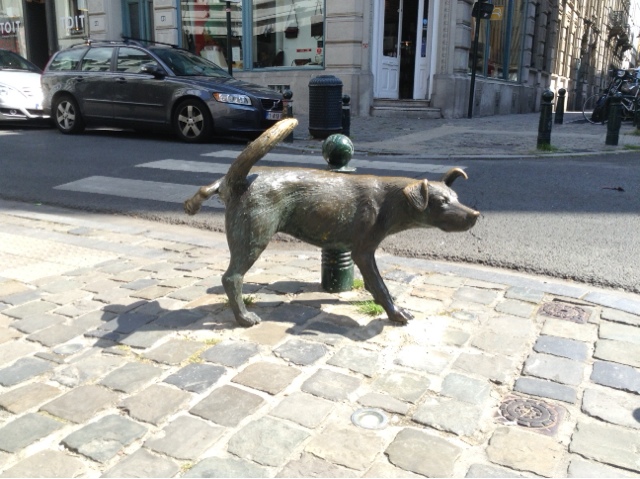
Another of the three peeing statues, this one of the animal variety. 

There was meant to be a gorgeous flower market in the main square on Friday mornings but unfortunately there was some sort of event on, blocking roads, setting up stages and musical instruments and painting strange hexagons on the pavement. This apparently took precedence over said market and it was unfortunately not on that week.

Needing a respite from the unusually sunny weather, we headed to L'inattendu, a cute little cafe with reasonably priced drinks and interesting decor. I especially liked the wine bottle wall you can see in the far right corner and its Latin motto 'In vino Veritas'. 

I however did not have wine, and stuck to trying Belgian and Dutch beer. Hoegaarden is possible to buy in New Zealand but it's so expensive I never do; it was a nice treat to drink it at an affordable price for once. 

Brussles was known for a neighbourhood of art nouveau, which until that point I hadn't really known anything about (I freely admit I still really don't) but I could appreciate its style, somewhat quirky and very ornate. 

We even went to an art nouveau cafe which was extremely pretty. The foyer was empty so we could take photos of the opulence of a bygone era. 

It was interesting to note that much of the graffiti on the walls were in English, although I suppose everyone we came across spoke English so it was a pretty well used language. This graffiti struck me with it's brightness and starkness.


Brussels Part I: In which a cunning chocolate plan is hatched

Our next destination was Brussels. We had decided that as Belgium was the home or Frites, we wanted to try the best and Lonely Planet told us this place made perfect chips. Although it was a little expensive (about 14 euros for my main) I couldn't resist trying rabbit cooked in Belgium cherry beer with mushrooms and frites on the side (doesn't just the description sound heavenly!?) It smelled and tasted just as great as it looked and the frites were just as fantastic as promised. 

Dame Blanche was written enticingly on the menu; Yannick tried the double chocolate one while I stuck to the traditional vanilla Icecream and chocolate sauce. Amazing! We also discovered the cream is much nicer in Europe, sweet without being disgusting, Yannick realised he actually liked it just after he'd offered his to me and I'd eaten it. Oops. 

One of the coolest things about Brussels were the cafés and bars, of which there were many. In particular the historic buildings and the establishments with character. Named 'Au Bon Vieux Temps' it was certainly a good time. Dating from 1695 and tucked down the tiniest alley so you'd never find it if you didn't already know it was there, this place was also added to my mental 'best bars' list. One of my favourite things was the stained glass window dominating the back side of the room.

After our relaxing respite, we headed for the central square to take in the gilded and ornate architecture. There was even a goose sculpture on the doorway of one of the buildings symbolising it's once held status as the Butchery guild. 

The Belgiuns seemed to have an fixation with peeing, with a grand total of three statues in the act; a little boy, a little girl, and a dog. According to the convoluted story from a tour guide - whom I eavesdropped on in vague dismay while trying to snap a photo-a little boy was turned to stone by a local witch for peeing on her doorstep and this shows that good things come in small packages. Or something. The tour guide had a slightly maniac air about him. 

This mall (and weren't malls so much prettier back then!?) was one of the reasons Brussles is often hailed as the best place to get chocolate from in a Belgium, including the original shop where praline was invented (yes we tried it, and yes of course it was nice! Personally I liked the white chocoalte coffee flavour better though). 

As we wandered down this street of delights, we spotted something magical. A Meert. This store that until then we had thought only graced the town of Lille now stood before my waking eyes. Gaufres were quickly bought and consumed. They even had a Gaufres recipe!! 

Wandering down the street, we noticed that some of the chocolate shops were giving out tasters, and Yannick soon hatched a devious idea. His cunning plan was to go into all the shops offering tasters and loiter innocently until we were offered some. It worked quite well too! 

In Brussels the smell of waffles followed you everywhere like a torturous trail for your nose. We decided it was high time we tried some real Belgiun waffles, and settled on a place with good reputation. While I still stand by my belief that pancakes are nicer, it was a rather lovely waffle, with soft melt-in-the-mouth pastry lightly dusted in icing sugar, and in my case,covered in fresh strawberries.