Tuesday, August 25, 2015

Prague: Communism Remembered

 Unlike the graveyards and opulent synagogues of bygone times showing the horror of the Jewish situation in Prague during World War II, communism left a less obvious mark. Yet there were hints of their hardships, if you just knew where to look. As we first stepped off the tram and into Prague city, we were greeted by this strange, somber face staring back at us. We spotted Jan Palach's name a number of times throughout the city, like a repeating motif on the tragedy of communism. I was curious about this communist past that I knew almost nothing about - except that it was so awful that Jan had, in an act of ultimate protest, set himself on fire on the 19th January 1969. 

Determined to broaden my horizons, we decided to visit the Communist museum of Prague. Ironically it was located within the same building as a casino, and next to a McDonald's. Very capitalist! It's a small, tucked away and dusty museum, which smells a bit funny but don't be put off -it's worth the trip. It's a rather eclectic collection from posters and statues to communist issued food. Set up by an American and a Czech, the museum is unapologetically biased. It is however fascinating in spite of - and even due to - this biased point of view. Words like 'evil, cruel and horrific' were bandied around freely. Although I had never been to a museum with such bias before, as the Czech private collector would have lived through such times, it was almost a testiment to how affected by Communism the nations people must be, even now. 
The weapon featured below may or may not have been used to reinforce the communist positon, but regardless it's badass. 


Another interesting fact I learned was why St. Wencslas square (pictured below) was such an un-square shape. More like an oblong with two wide avenues going through it, it was in fact modified and widened so that Soviet tanks could roll in en masse to keep the communist regime. Incidentally speaking of tanks, the first tank to enter St Wencslas square (a few years before to liberate the Czech people in World War II) was hailed as a national monument by the communists and given a place of honor in this square. After the fall of communism, the tank came to symbolise to the Czech people their oppression, and in 1991 an art student named David Cerny and his friends painted the tank pink in the middle of the night. Cerny was promptly arrested for 'public disturbances' and it was painted green again. This might have been the end of the story, except that fifteen members of the newly elected parliament painted the tank pink again in protest of Cerny's arrest! Cerny was released and the tank was demoted from it's status of national monument. After a few more rounds of being painted green and then mysteriously turning pink again soon after, the tank was removed permanently. 

Perhaps the most interesting thing for me were the many propaganda posters tacked to the museum walls, the colours faded but the messages just as accusing. Although now they seem almost funny, their messages so blatantly full of lies and slander and anti-west sentiments, they were a product of their time, a time when these were the only news of the outside world people were able to get. 
The poster on the right reads 'We are building Communism, we unmask the saboteurs and enemies of the Republic, we are strengthening the front of peace!' My favourite one however (apart from the hybrid Statue of Liberty-Spider-man poster below) was one showing American aeroplanes raining poison pellets from the sky onto potatos. Why this hatred of potatos you may ask? In fact, a completely natural disease struck the potato crops leading to severe economic problems - so as not to be blamed and use the opportunity to strengthen their own positon - the communist government spread posters blaming it on an attack by the dastardly Americans. With no other news outlet, people knew no better (and isn't that a bit terrifying?)

Communist chocolate! Huh, funny how much that sounds like consumerism. 

Imagine a situation where anything you said, in passing, near an open window, to your neighbour, could be passed on as treason.The secret police were everywhere, and this narking was encouraged. One propaganda poster read 'No American agent shall get through our village! Help the National Safety Corps protect your United Agricultural Co-operative against Western Imperalists'. Or in other words, report anything and everything to the Secret Police and don't be surprised when people start disappearing. The photo below shows how a typical Secret Police interrogation room would look. A photo of Stalin glaring sternly at the world hung behind the desk. What really set me on edge however was the telephone on the desk - at random intervals it would ring, echoing around the bare room and making my fingers itch to answer it. 

On the 20th anniversy of Jan Palach's death in 1989, protests in his memory and as a criticism against the Comminist regime began. These were harshly suppressed by the police, however this 'Palach week' is thought of as one of the catalysts in the dismantling of the communist regime in Czechoslovakia ten months later. As I admired the pure joy on the face of the woman at the moment of the deconstruction of the communist regime, I couldn't help but notice the man on the bottom left looked strangely like Kennith Brannigh. 

Named the 'Velvet Revolution' due to it's non violent nature, protests culminating on the 24th of November 1989 caused all of the top communist officials to resign. Legislature was changed to no longer include Communist power monopoly, and on December 29, 1989, a new president was elected, the first non-communist government since 1948. As the saying goes, the fall of communism 'took ten years in Poland, ten months in Hungary, ten weeks in Eastern Germany, and ten days in Czechoslavakia'. 

These statues commemorate the Communist oppression in the Czech Republic. Open to interpretation, I think it shows the people who disappeared, the unamed and forgotten taken by the secret police and quietly wiped from history. Not only this, but also how downtrodden the common people became under the communist regime, how they became less, slowly bowed, broken and withered away by their stifling oppression. 

Saturday, August 22, 2015

Prague: Which came first, the Chicken or the Stingray?

Every hour in the main square of Prague, the astronomical clock put on a show - or this is how it was sold to us anyway. Come the hour, we dutifully stood gazing up at the ornate clock, ignoring the seething masses rife with selfie sticks. The bell tolled (and that was the most dramatic part) what followed was a rather dull procession of little figures stiffly moving along their track. I would recommend seeing the clock, as it's rather beautiful - however make sure you avoid going on the hour so as to avoid the unpleasant crowds. 

We arrived early for Market day and wandered around enjoying the atmosphere. It was far too early for lunch, so we decided we would find wifi and a drink for a few hours, and then go back to the market for something delicous. We found a restaurant with air conditioning (a welcome relief from the blazing heat) and wifi, however it wasn't quite open yet. While waiting on a nearby bench, I witnessed this magical box. It seemed to be a little library, as people would come up, open the door (no key needed) and place a stack of books in their bag and wander off! I assume it was on some kind of lending system as it was very popular, in the short time we sat there I witnessed three people taking out books! Very strange, but very cool. 

Back to the market we went, only to discover to our dismay many of the stalls were already gone! Luckily the one we had scoped out that morning was still there, and we were soon tucking in to Banh Mi, one Yannick and Necia's recommendation. It was my first taste of Vietnamese food and extremely nice, involving baguette, pâté, delicous pork and fresh greens. 

Our next stop the Minature museum - an oddity I had read about in Lonely Planet, I wasn't sure what to expect. Based solely on the work of Anatolij Konenko, a Siberian who works with miniatures as a form of art. His first work involved putting horseshoes on a flea which took him a staggering seven and a half years. Armed only with this knowledge, we entered the museum. A simple room, full of microscopes - and beneath each one a piece of art, magnified so the human eye can appreciate such tiny detail. It was strangely beautiful. 

My favourite were these camels in the desert, held in the eye of the needle. The extremes gone to for this meticulous work is just mind blowing. Tools often used for eye surgery are used, and the artist can only work between heartbeats to keep a steady hand. His micro-paintings were perhaps the most impressive. Konenko spent twelve years developing this technique, creating handmade brushes made up of individual fibres under a microscope. Not only this, but when applying the actual paint, as it is in such minute amounts each stroke must take not more than half a second, or else it dries. 

Coming out the museum, blinking in the daylight and my mind blown, we wandered past this church which Yannick tried in vain to get in to (twice!). I noticed a wedding had left pretty pink petals in its wake, strewn across the cobblestones. 

On the same square was the Strahov library, although the beatiful book halls were closed off to visitors to preserve the ceiling frescos, it was possible to peer in. This however was not the highlight. In the foyer a collection of oddities resided, mementos kept by sailors from back in the day who would prepare sea creatures in such a way as to convince landlubbers that sea monsters really existed. My favourite was what we decided was a splayed stingray gruesomely combined with a dried chicken's head. Unfortunately photos cost extra so no wonderful photo of the aforementioned 'sea monster' can be produced. 

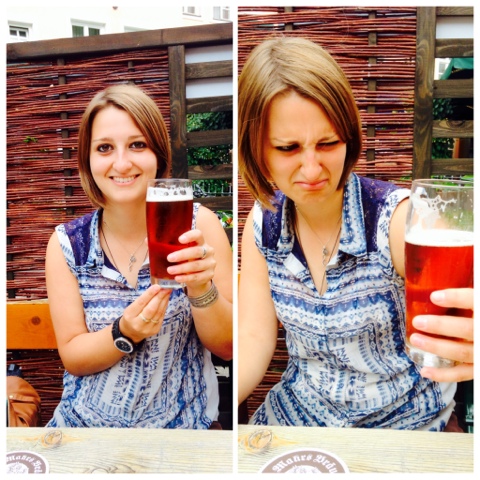
Tired from our day's escapades, we stopped at a bar for a much needed drink. I tried the Czech beer Pilsner Urquell on tap, and found it very much to my liking. 


Wednesday, August 19, 2015

Prague: Exploring the Jewish Quarter

Prague is a city with a long and tragic past, the Jewish population murdered by the Nazis, their country signed over to others with no say from Czechoslavakia itself, and their people brutalised under a harsh communist regime. This is a city of two Defenistrations (one involving a dung heap), countless protests and eventually, victory. For having such a dark past, it was a beautiful, cultural, colourful and friendly city.

We began our adventure in the Jewish quarter, getting a pass to a number of Synagogues which proved to be well worth the money. Starting with the Maisel synagogue, we found it held a number of artefacts as it had been mainly turned into a museum. It housed many objects displaced during World War II by Nazis and it is theorised that Hitler planned this synagogue to be a 'museum to an extinct place'. The one positive of this horrific ideal is that it helped to keep many priceless and culturally important artefacts safe. 
This innocent and indeed rather fancily written letter is in fact an edict by Empress Maria Theresa expelling all Jews from Prague in 1744. 

Our next stop was the Pinkas synagogue, although far older then the Maisel- dating to 1535- it looked the same age. I suppose it must have been heavily renovated over time. The most memorable factor of this small synagogue was the writing on the walls. Over plain whitewash the names of the 77,000 Czech Jews who perished in the Holocaust. The number of names was utterly staggering, and difficult to to take in that line upon line of these words symbolised children, women, men, grandparents - whole families, all of them wiped out. Upstairs this was reinforced with a moving exhibition showing children's drawings from the time. Not only of occupied Czkechsolvakia, but also deportation, the work camps, and death camps. The camp conditions, domateries and frightening prison gaurds drawn in childish scrawl were extremely sad. 

Passing through this somber church we came to a back entrance, leading through the Old Jewish Cemetary. Opened in 1439 and closing during the 1700s, it was spared during the Nazi regime that saw many other graveyards, synagogues and places of importance destroyed. Possibly it is due to Hitler ordering this graveyard to be kept intact - for the goal of using it as part of the 'Museum of an Extinct Race' after the final solution to the Jewish problem was carried out - that ensured its survival during World War II. 

The Spanish synagogue was the highlight for me simply for its beauty.  Built in 1868 in a heavily Moorish style, the busy golden patterns created a stunning visage.

Used by the nazis during World War II as a repository for jewish items, this ensured its survival. As to why it is called the Spanish synagogue, funnily enough no one really knows. 

One of my favourite legends that originated from Prague was the mysterious Golem, built by a 16th century rabbi to defend the Prague ghetto from anti Semitic-attacks. Legend tells that the Golems body lies in an attic of the Old-New synagogue until needed again, when it will be restored back to life. 


Monday, August 17, 2015

Behind the Iron Curtain: The Devil walks among us and his name is Billy

It's 33 degrees. Sweat trickles down my arms and legs as I sit in the shadow of the third largest synagogue on the world. I'm in Plzen, home to Pilsner beer and not apparently, much else. 
The buildings are the same bright colours I've seen everywhere since crossing the border. It's hard to believe this was a Communist country only twenty five years ago, hidden behind the impenetrable Iron Curtain.
Plzen did in fact have an colourful past in regards to the Communist takeover of 1948. It's not really something you learn about in school and I knew very little about it, so it was interesting and awful to learn about these Eastern European countries which suffered brutality and harship under Communist regime - and yet in the face of this everyday people fought against it as hard as they could. The communist takeover led to the Plzen uprising which was harshly suppressed by Communist officials. Their most evocative move perhaps however was when West Germany sent a homing pigeon which became lost near the border - it returned two days later bearing strong anti communist messages and signed 'Unbowed Plzen'. This country was a place of interesting history indeed. 

This wasn't however, my first experience in this strange new land. That began the day before, following the footsteps of Goethe into Loket, a tiny medieval town framed by a hilltop castle and craggy outcrops from which tiny goats nimbly navigated their way down, the sad bleats of their kids struggling to emulate their spry parents cutting through the relative silence.  

An information board informed us that these little animals were 'Camaroon' goats, who could climb everywhere and never respected the barriers the council put up for them. Furthermore, the goats were apparently aware of their dominance, and watched the council members 'attempts to secure the impenetrability of the run with malicious looks and leers'. It ended with a note about the medieval statement that the goat is a reincarnation of the Devil must have come from a gardener. 


The highlight of this mountainside village was undoubtlty the castle, used in the Bond film Casino Royale and once known as the 'Impregnable Castle of Bohemia' this castle was laid siege to numerous times but without success. Sitting on the rocky crags with the river far below, it was breathtakingly beautiful. To add to the atmosphere, in the warm light of the sunset, the strains of a boisterous singer and his piano drifted across the bridge.


This is the Czech Republic. 

Sunday, August 16, 2015

Bamberg and Nuremberg: That the Sun Warms People and Stone

Our journey towards Czech Republic took us towards the town of Bamberg which I was interested in stopping in to try the curious local speciality of 'smoked beer'. However it turned out there was so much more to the town than I expected. First, we scored a gorgeous campsite by the river where we were able to put our tents right by the banks and watch the sunset over the water with nary a ripple. Swimming in the heat of the day was also unforgettably lovely and we happily deemed this our favourite campsite and spent a rare day simply relaxing here. 

Bamberg surprised me in fact, turning out to be an attractive Medieval town built on rushing waterways. I had expected only beer, but Bamberg provided history -and oodles of it. The centre of the Holy Roman Empire at one point, a focal point of witch trials ending with a tally of over 1,000 victims, and even the temporary relocation of the seat of government of Bavaria when Munich came under communist control in the years following World War I. 

The problem of Bamberg was in fact, the beer. Excited to try something new, I soon found out why it remained a 'local' specialty. Yannick, after sampling mine, carefully analysed the flavour as 'off Pastrami', while I was leaning more towards the subtle taste of 'matured with old rubber'. 

We passed a very old pharmacy on our wanderings which I thought was rather cool, it had old bottles and items from the 1600s - back when going to the doctors was probably as risky as not going! 

The town also had a monastery, although it had been turned into an elderly peoples home (ones with buckets of cash judging from the security and architecture) the facade was pretty to look at and the monastery gardens were very enjoyable to wander. The remains of old orchards dotted the slopes in uniform lines, craggily old apple and pear trees with the fruit lying abondoned on the ground, long forgotten.  

My last view of Bamberg as we left it, the rushing of water mingling with the high spirited shouts of tourists watching the sun set from the old stone bridge. 

Nuremberg was our last city in Germany and although I had no real expectations it in fact provided me with lasting memories. Not only was Necia able to satisfy her craving for Pimms, but we were also able to try the famous Nuremberg sausages that helped make a name for the German bratwurst - and they were very good too! Called 'Rostbratwurst' these sausages can only be made in Nuremberg - they are even on an official registers recognising locally produced specialties! 
These small sausages are eaten in groups of three in a bun (called Weggla) or in groups of six, eight, ten or twelve by themselves. The reason for their small size has a few amusing origin stories, most of which seemed to involve stuffing these sausages through small spaces. One such tale goes that inns were required to close early, so innkeepers made these savoury delights small so they could still give guests who were locked out for the night dinner by feeding them through the keyhole! Another story states that criminals in Nuremberg prison were fed these sausages through a special hole drilled through the wall. I found both these stories somewhat questionable, but enjoyed them nonetheless! We were also lucky enough to visit Nuremburg on market day which meant we couldn't resist buying a couple of punnets of raspberries which we consumed sitting on the sun-soaked stones at the foot of the cathedral. 

The second culinary delight of Nuremberg is it's famous gingerbread, called Lebkuchen. It reminded me of a mini Christmas cake, soft and chewy and lightly iced and spiced and lovely. I suppose they have had a few hundred years to perfect the recipe as it was invented by monks way back in the 13th century.


Nuremberg is of course known for its role in World War II, notably the Nuremberg rallies held by the Nazi party which promoted Nazi ideals and propaganda. This was also the site where the laws were passed stripping Jews of their citizenship. It was of course symbolic then that this is also the city of the Nuremberg  trials - where Nazis were brought to justice.
 The cathedral of Nuremberg - called St. Sebald - was a poignant reminder of the destruction wreaked by World War Two. Nuremberg was flattened by Allied bombing and the church itself was heavily damaged. In simple pictures and words a small exhibition called 'St. Sebald: a Monument to Peace' displayed the rebuilding of the church as representation of hope. I have copied my favourite words of the exhibition below:

'20th April 1945...
The guns are silent.
Nuremberg: fallen 
Laid down in the horror of a war
No one had imagined it would be like that...
Torn, broken through, empty 
Sebald's towers reach towards Heaven'.

'Peace - what is peace? 
That we can go through the ruins
Without fear of bombs?
That the sun warms people and stone
As if nothing had happened? 
That the horror is already beginning 
To belong to the past? 


17. December 1992
100 000 citizens 
Carrying burning candles 
Form a circle round the heart of the city. 
The seeds of violence 
Must never germinate again 
In our city!'


The Culinary Camping Connoisseur #7: Boeuf Haché entre Bap (avec Toppings)


Boeuf Haché entre Bap avec Toppings (serves three) 

Ingrediants
1 white onion
 3 white burger buns (sesame sead or poppyseed buns could be used as a change) 
Lettuce
One large tomato 
Dijon mustard
3 slices of Emmental cheese 

Mince 
500g beef mince meat 
Salt
Pepper
1 egg
Breadcrumbs
Basil 
Garlic 

Equipment 
Cutting board
Knife
Frying pan
Large bowl for preparing patties 
Gas cooker 
Large wooden or plastic spoon for flipping 

Method 
1. Prepare the ingrediants, dice up your onion, slice tomato and finely chop garlic. Wash lettuce if necessary 

2. Prepare the mince by placing meat into a large bowl, crack lots of pepper, salt and basil in (depending how herby you want it). Crack in an egg and work it through meat, add breadcrumbs to get a texture that sticks together without being slimy and obviously eggy. Add in chopped garlic and work it evenly through.

3. Fry onions on a medium heat until golden, set aside.

4. Drizzle some oil into the pan on a medium-high heat. Once hot, place the shaped mince patties in the pan. Sear on both sides and then lower the temperature to cook through. Cook to your liking.

5. While the patties are cooking, prepare the buns. Slit them sideways but not all the way through so your burger won't fall apart and spill hot juices on your fingers. 
Spread mustard on bread if using, then place lettuce, tomato and onions on the open 'lid'. 

6. When the patties only have a few more minutes until they are done, place cheese slices on top and let them melt to your satisfaction. 

Take our the patties and place them on the bottom of the bun. Push bottom towards the top to connect the burger without losing all your ingrediants. Now it is ready to eat. 

Serve with a nice light Czech beer, such as Pilsner Urquell


The Culinary Camping Connoisseur #6 : Caprese Salad

Caprese Salad (serves three) 

This dish can be an entree or main depending on how hungry you are. To bulk it up you could have it on slices of bread, or with a rocket salad. 
This is a great easy dish if you don't have a gas cooker, don't want to cook or unable to do so due to raging wildlife (e.g. Wasps). 

Ingrediants
1 punnet Cherry tomatoes 
2 large balls of Bufala mozzarella 
Extra Virgin olive oil
Balsamic vinegar
Salt
Pepper
Basil (fresh if possible) 


Equipment 
Chopping board
Knife 


Method
1. Chop your tomatoes roughly, cut thick slices of mozzarella 

2. Sprinkle tomato and mozzarella with salt, pepper and basil (if dried) 

3. Place your mozzarella slab on the bottom, place tomatoes as wanted on top

4. Drizzle olive oil and vinegar to taste, add fresh basil if using

Note: if using bread rounds, place mozzarella directly on bread these first then follow above steps

Serve with a light prosecco